ITSM and ITOM get lumped together so often that most IT leaders can’t cleanly explain where one ends and the other begins. That confusion costs real money in duplicated tooling, tickets that bounce between teams, and outages nobody owns. Here’s a practical breakdown of what each discipline actually covers, where they legitimately overlap, and how to structure teams and tools so the two work as one operating model instead of two silos.
Two Disciplines, One Underlying Question
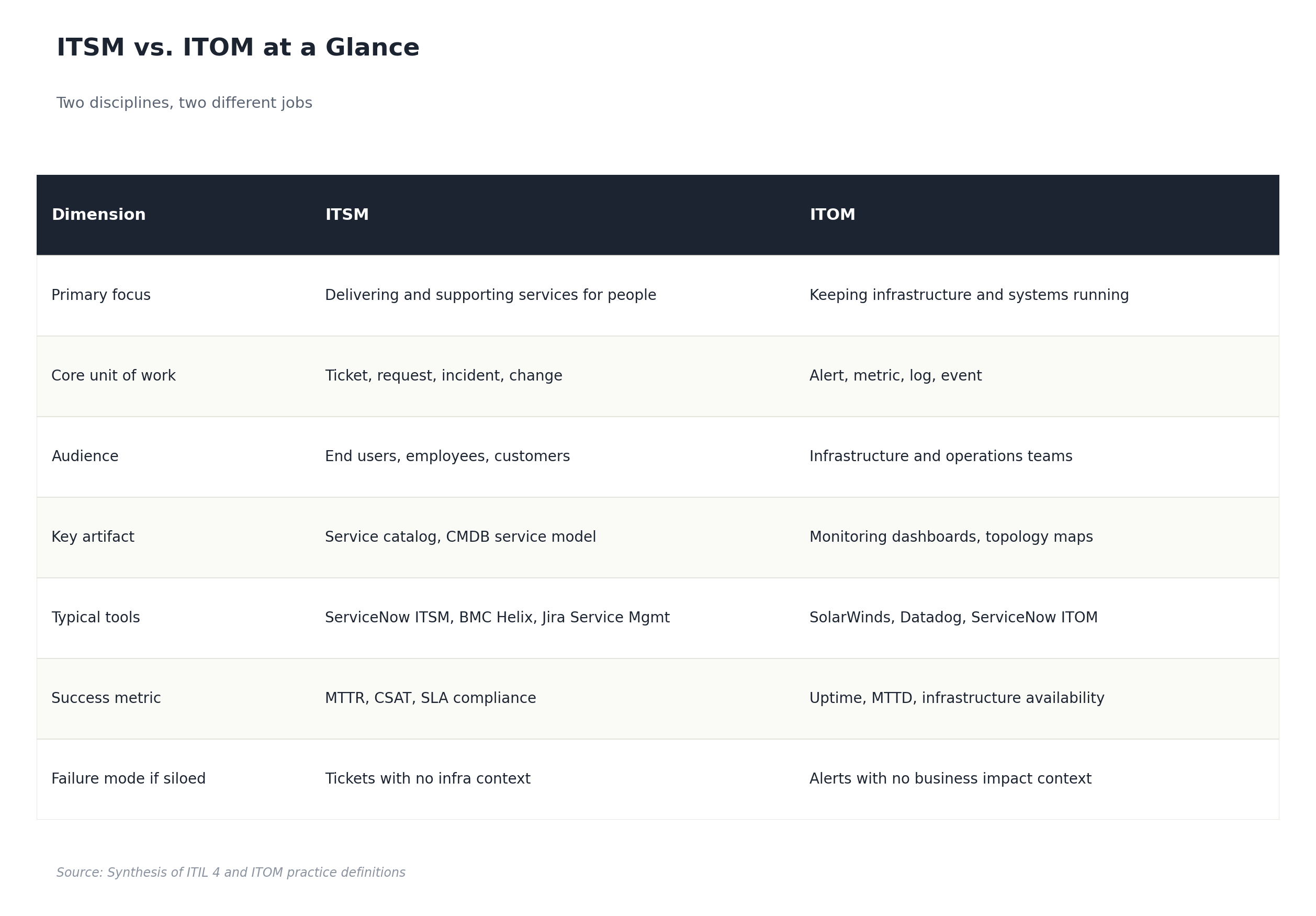
Both ITSM and ITOM exist to answer the same basic question a business asks IT: “can I trust this to work?” They just answer it from opposite ends of the stack.
IT Service Management is the human-facing half. It’s the set of practices — incident management, problem management, change enablement, request fulfillment, knowledge management, service level management — that ITIL 4 organizes as a value chain running from Plan through Engage, Design & Transition, Obtain/Build, and Deliver & Support. ITSM cares about the experience: did the user get what they asked for, was the outage communicated, did the change go through without breaking something else. It’s reactive by design in places (someone opens a ticket) and deliberately process-heavy, because consistency and auditability matter when you’re the interface between IT and the rest of the business.
IT Operations Management is the infrastructure-facing half. It covers event monitoring, alerting, observability, network and server management, capacity and performance management, and discovery — the automated scanning that finds what’s actually running in your environment. ITOM doesn’t have a single canonical framework the way ITSM has ITIL; it borrows heavily from DevOps, SRE, and vendor-specific operations models. Its job is to know, continuously, what’s healthy and what’s degrading, ideally before a human ever notices.
Put simply: ITSM manages how people ask for help and how IT responds. ITOM manages whether the systems underneath are actually working. One is oriented around requests and tickets, the other around telemetry and signals.
Why the Split Exists at All
The split isn’t arbitrary bureaucracy. Service management and operations management grew up solving different problems with different cadences. A service desk analyst working a change request operates on a timescale of hours or days and needs approval chains, documentation, and a clear audit trail. A network engineer watching a spike in packet loss needs sub-second alerting and automated remediation, not a change advisory board. Forcing both into identical workflows slows the fast side down and under-governs the slow side.
What Each One Actually Owns
ITSM’s core practices
Incident management restores service after something breaks. Problem management goes after root cause so the same incident doesn’t recur. Change enablement governs how modifications get planned, approved, and rolled back if needed. Request fulfillment handles the routine asks — new laptop, access to an app, a password reset. Knowledge management captures the fixes and workarounds so the next analyst isn’t starting from zero. All of it runs against a service catalog and is measured in SLAs, customer satisfaction, and first-contact resolution.
ITOM’s core practices
Event management ingests signals from infrastructure and applications and decides which ones matter. Monitoring and observability track performance, availability, and increasingly the internal state of distributed systems (logs, metrics, traces). Discovery automatically finds servers, containers, cloud instances, and the relationships between them. Capacity and performance management project forward so nobody gets surprised by a resource ceiling. All of it is measured in uptime, mean time to detect, mean time to resolve, and increasingly cloud spend efficiency.
Where the Overlap Is Real, Not Theoretical
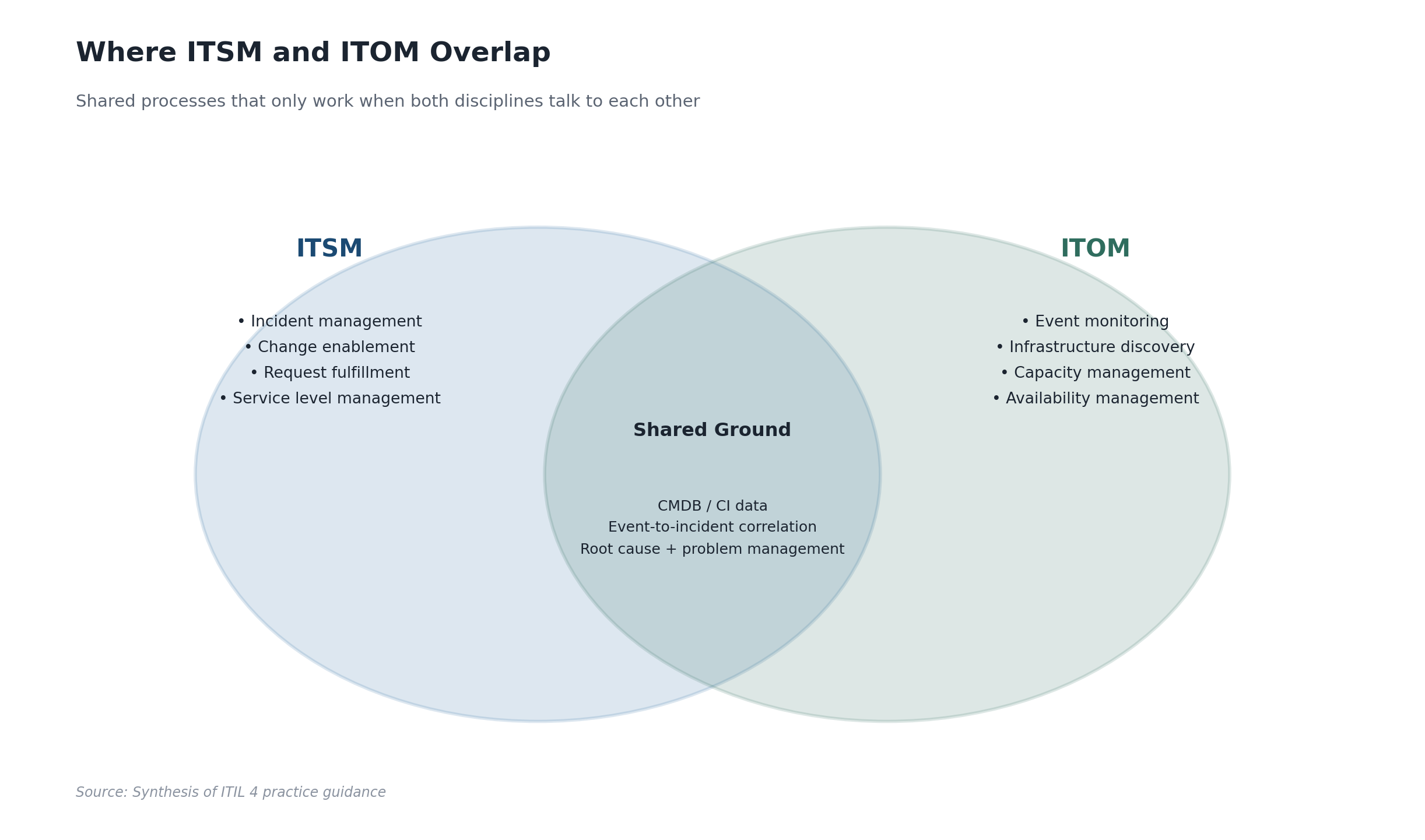
This is the part most comparison articles skip past, and it’s the part that actually matters operationally.
The CMDB is the shared backbone
A configuration management database sits at the intersection almost by definition. ITOM’s discovery tools populate it with what’s actually running; ITSM’s change and incident processes depend on it to know what’s affected when something breaks or when a change is proposed. If discovery and CMDB are owned only by the operations side and never reconciled against what the service desk sees in its tickets, you end up with a CMDB that’s technically accurate about infrastructure but useless for incident triage — nobody can answer “what services does this server support” fast enough to matter during an outage. That’s a governance problem, not a tooling problem, and it’s one of the most common reasons CMDB initiatives quietly stall.
Event-to-incident correlation
An ITOM monitoring stack throwing off hundreds of alerts an hour is operationally useless unless something maps those alerts into a small number of actionable incidents that ITSM workflows can act on. This is the literal seam between the two disciplines: event correlation and de-duplication logic decides which raw signals become a ticket, who gets paged, and what priority it’s assigned. Get this wrong and you get alert fatigue on one side or blind incidents on the other — a P1 outage nobody flagged because the signal existed but never made it into a workflow a human could act on.
AIOps is accelerating the blur
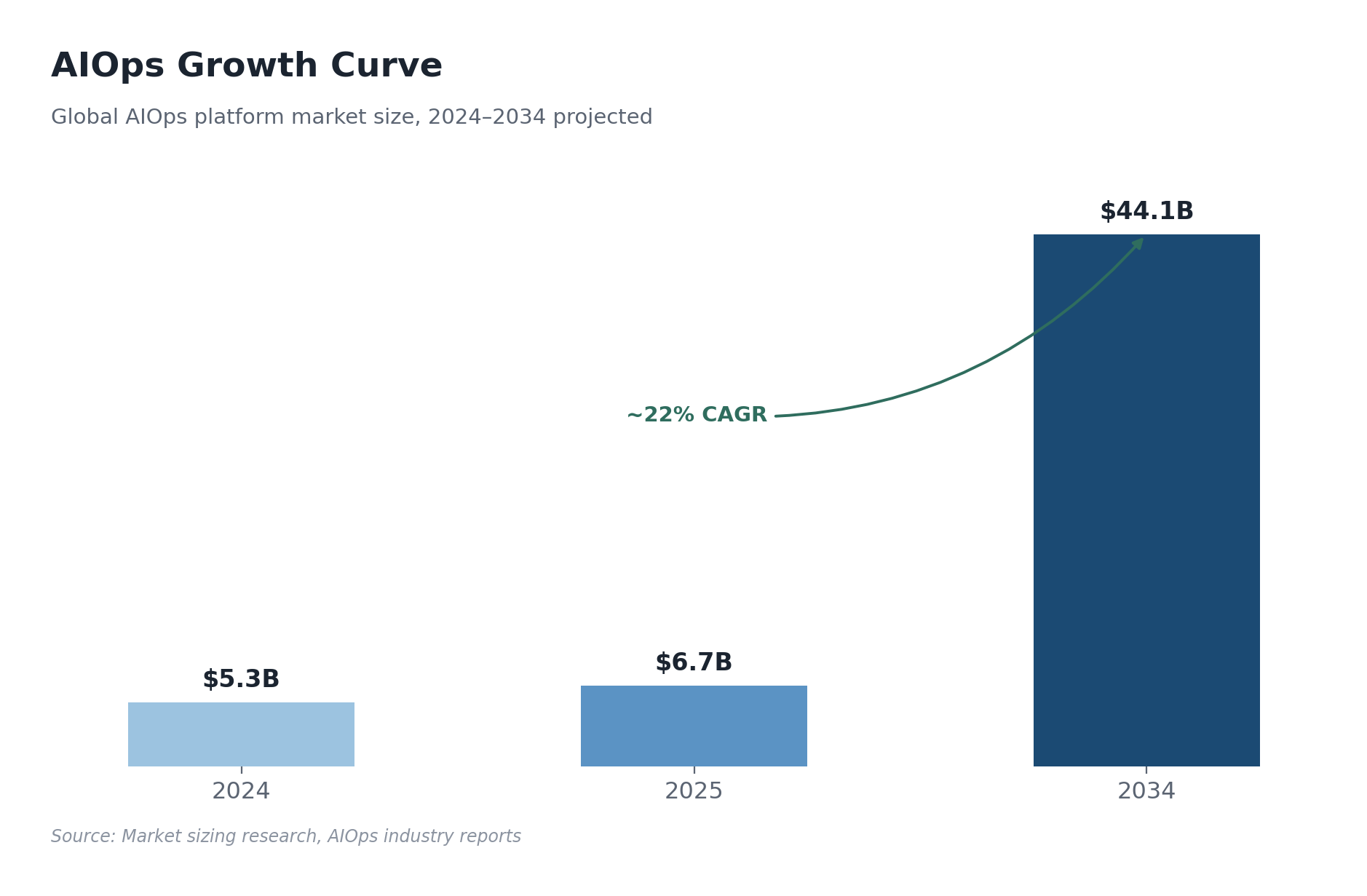
AIOps — applying machine learning to event correlation, anomaly detection, and noise reduction — sits squarely on top of both disciplines and is why the line between them keeps moving. The AIOps platform market was valued at roughly $5.3 billion in 2024 and around $6.7 billion in 2025, with forecasts putting it near $44 billion by 2034 at a compound annual growth rate above 20%, according to Grand View Research and GMInsights market analysis. That growth is a direct response to a real problem: BigPanda’s research on incident response notes that organizations can spend up to half of total mean-time-to-resolve simply hunting for the information needed to investigate an incident, rather than fixing it. AIOps tooling exists to close that gap by correlating ITOM telemetry automatically and handing ITSM a context-rich incident instead of a pile of raw alerts.
The practical effect: a vendor’s “ITOM module” today often includes automated ticket creation, and a vendor’s “ITSM module” often includes native monitoring integrations. The tooling boundary between the two has gotten genuinely blurry even where the disciplinary boundary — process versus infrastructure — hasn’t.
The Cost of Getting the Split Wrong
Strong ITSM without a mature ITOM function tends to produce a service desk that’s fast and polite but permanently reactive — every incident starts with someone noticing something’s broken rather than the system flagging it first. Strong ITOM without ITSM discipline produces the opposite failure: a monitoring environment throwing off enormous alert volume with no structured way to prioritize, route, or resolve it, so engineers drown in noise instead of acting on signal.
Neither failure mode is cheap. IT downtime research from ITIC’s 2024 survey found that 90% of mid-size and large enterprises now put the cost of a single hour of downtime above $300,000, and New Relic’s 2024 observability research found a median of 77 hours of annual downtime from high-impact outages, with engineering teams reporting they spend roughly 30% of their time responding to disruptions rather than building. Separately, IDC has warned that skill shortages will affect the large majority of IT organizations through 2026, adding pressure to run leaner, more automated operations rather than throwing more headcount at alert triage. None of that gets fixed by picking better tools alone — it gets fixed by deciding, deliberately, how the operational and service layers hand off to each other.
How Organizations Actually Bridge the Two
There’s no single right org chart, but a few patterns show up repeatedly in mature shops.
Some organizations keep ITSM and ITOM as separate teams but force integration at the tooling layer — event management feeds directly into the service desk’s incident queue, with agreed rules for what auto-creates a ticket versus what stays a monitored event. Others build a dedicated command center or NOC/SOC-adjacent function that sits between the two, owning correlation logic and escalation criteria as its full-time job. A newer pattern, especially in larger enterprises running multiple service providers, borrows from Service Integration and Management (SIAM): a retained integration layer that coordinates ITSM and ITOM data across internal teams and external vendors so no one provider’s tooling becomes the single source of truth by accident. Frameworks like IT4IT push this further by treating the whole IT value chain — strategy to portfolio, requirement to deploy, request to fulfill, detect to correct — as one connected reference architecture rather than a stack of disconnected practices.
Whichever structure you pick, the actual test is simple: when an event fires at 2 a.m., does it become an actionable, correctly prioritized incident without a human manually stitching together monitoring dashboards and ticket queues? If the answer is no, the org design or the integration — not the individual tools — is the problem.
The tooling side of this is where vendor-neutral thinking earns its keep. A ServiceNow shop might use ITOM Discovery and Event Management to populate the CMDB and auto-generate incidents; a BMC Helix environment might lean on Helix AIOps for the same correlation job feeding Helix ITSM; an Atlassian-centric team might route Opsgenie alerts into Jira Service Management. The mechanics differ, but the design question is identical in all three: who owns the correlation rules, who reviews false positives, and who’s accountable when the CMDB the incident points to is stale. Picking the platform is the easy part. Deciding governance for that handoff is the part that actually determines whether the integration holds up under real incident load.
Signs the Seam Is Leaking
A few patterns tend to show up in organizations that haven’t deliberately bridged ITSM and ITOM. Change tickets reference a CMDB that operations teams privately admit they don’t trust. Analysts triage incidents by pinging someone on Slack to ask “is this thing even down” because the monitoring data never made it into the ticket. Post-incident reviews keep surfacing the same root cause under a different symptom, because problem management and capacity trending live in different systems that nobody cross-references. None of these are tooling failures in the strict sense — they’re symptoms of an ITSM/ITOM boundary that was never explicitly designed, just left to happen by default.
This is where a methodology matters more than a product choice. Desqcon’s AEIOU framework — Automation, Edification, Integration, Operations, User experience — was built around exactly this seam. Automation and Integration cover the event-to-incident mechanics; Operations and User experience keep the outcome measured from both the infrastructure and the end-user side; Edification is the deliberate, ongoing skills investment that keeps a team ahead of tool sprawl instead of drowning in it. Because the framework isn’t tied to a single platform, it works whether the underlying stack is ServiceNow, BMC Helix, Atlassian, or some mix acquired through M&A — the assessment is about maturity and process design, not which vendor’s logo is on the login screen.
Where to Start
Most organizations don’t need a rip-and-replace of either their ITSM or ITOM tooling. They need an honest look at where the seam between the two is actually leaking — duplicate CMDBs, alert floods with no correlation logic, incidents that take longer to triage than to fix. A vendor-neutral ITSM/ITOM maturity assessment is a low-friction way to get that picture before committing budget to a platform decision. If that’s useful, Desqcon’s consultants are glad to walk through what a baseline assessment would look like for your environment.