Software licenses don’t manage themselves, and neither does the data about them — yet most organizations still track software spend in a spreadsheet disconnected from the CMDB that maps how those applications actually run. When SAM data isn’t tied to configuration items and ITSM workflows, license decisions get made blind, audits become fire drills, and provisioning turns into guesswork. Connecting the two isn’t a nice-to-have integration project; it’s the difference between managing software as an asset and just buying it.
The Silo Problem, and Why It Persists
Ask most ITAM leads where their software license data lives and you’ll get an honest answer: in a licensing tool, maybe a spreadsheet, occasionally a SAM module bolted onto the service desk platform. Ask where that data connects to the CMDB or to change and incident records, and the answer gets quieter. This isn’t negligence — it’s how these disciplines grew up. Configuration management came out of infrastructure and operations. Software asset management came out of procurement and finance. They solved different problems for different stakeholders, and nobody forced them to talk to each other.
The result is predictable. A server gets decommissioned and the license sitting on it doesn’t get reclaimed, so it just keeps depreciating on a shelf somewhere. An incident ticket comes in for a production outage and the responder has no idea the affected application is running on a license that’s about to expire. A new hire needs Adobe Creative Cloud and the request goes through approval without anyone checking whether there’s an unused seat sitting idle in another department.
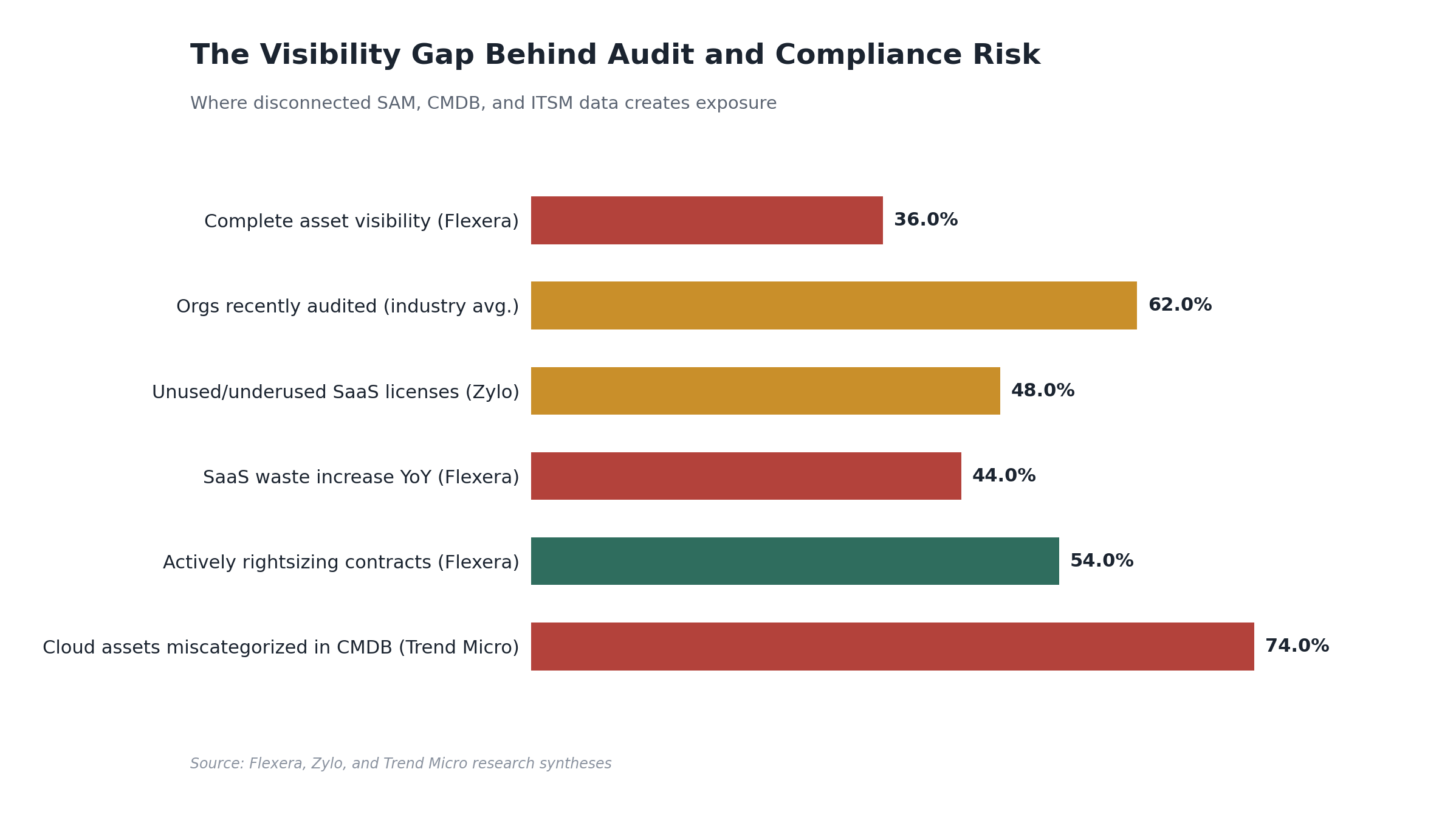
None of this is hypothetical. Flexera’s 2026 State of ITAM Report found that only 36% of organizations have complete visibility into their IT estate, with 62% describing their visibility as partial at best. Visibility into AI software deployments specifically sits at just 31%. You can’t run accurate license reconciliation, right-size a renewal, or defend a compliance position in an audit when you can’t see what’s actually deployed — and the CMDB, when it’s trusted and current, is usually the best available record of what’s deployed where.
Putting Software Where the CMDB Can See It
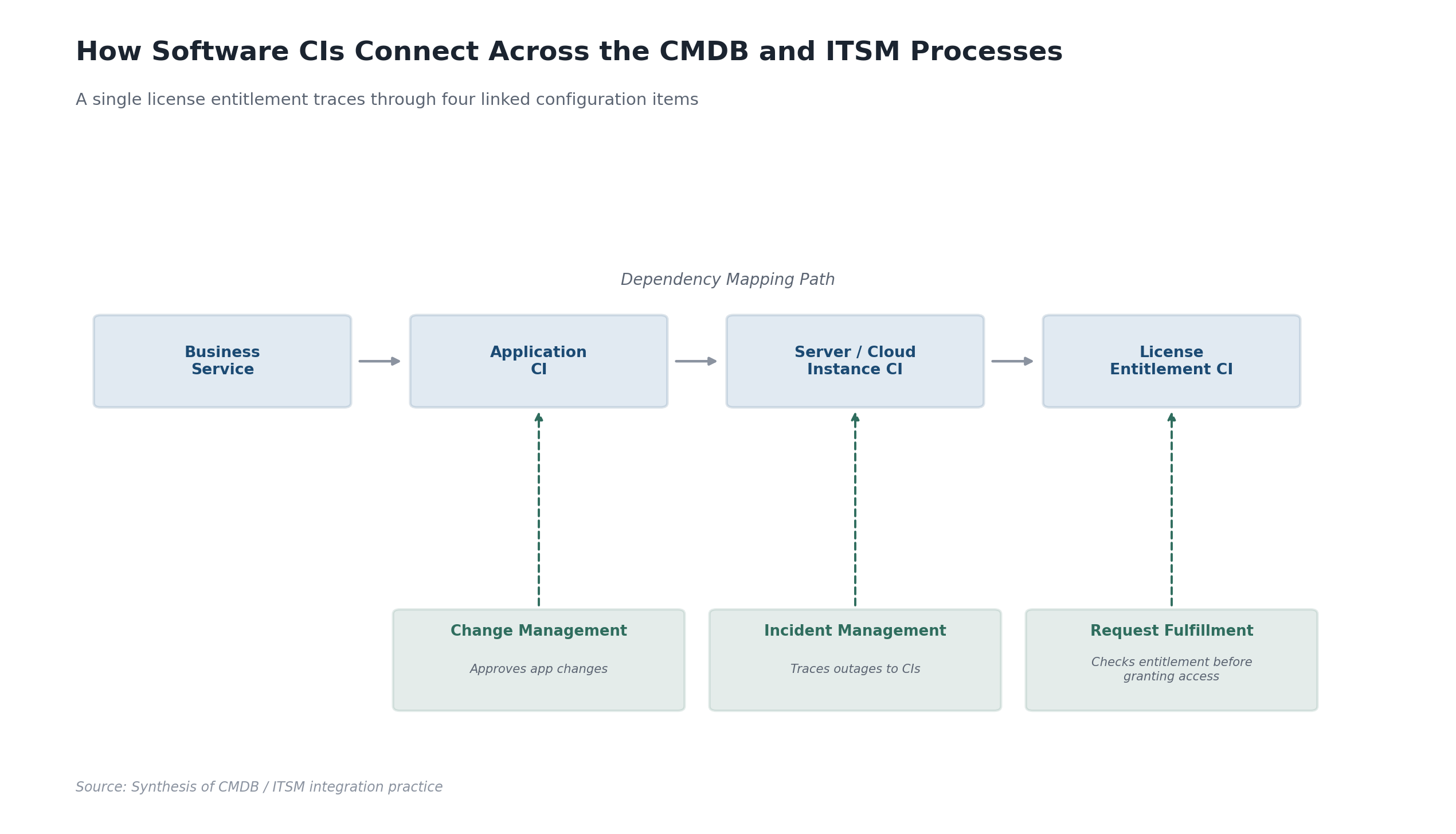
The fix conceptually is simple: treat software entitlements and installations as configuration items, and link them the way you’d link a server to a business service. A license CI connects to the application CI it’s assigned to, which connects to the server or cloud instance it runs on, which connects to the business service it supports. Once that chain exists, a question like “what breaks if we retire this server” stops being a research project and becomes a query.
This matters more than it sounds because dependency mapping is the actual payoff, not the CI relationships themselves. If a database server hosting a licensed ERP module needs a maintenance window, the CMDB should be able to tell you every downstream service, every user population, and every license entitlement tied to that box in one look. Without that mapping, teams either over-communicate (blast every stakeholder “just in case”) or under-communicate (miss the one business unit that actually depends on it). Both cost time and trust.
There’s also a discovery angle worth being honest about. Even organizations that invest specifically in SaaS management tools routinely find they’re running roughly three times more applications than IT officially tracks, according to research cited by Everest Group and SaaS management vendor Zylo. That gap exists because software gets installed, provisioned, or subscribed to outside any process that touches the CMDB. Every one of those shadow applications is a CI that doesn’t exist, a dependency nobody mapped, and a license nobody is managing. Gartner’s shadow IT estimates run as high as 30-40% of enterprise IT spending happening outside official channels — money moving through no configuration record at all.
What Good CI Modeling Actually Looks Like
A software CI worth having in the CMDB needs a few things: a clear owner, a linked application service, an entitlement count (seats, cores, or whatever the vendor’s metric is), and a renewal or expiration date. Skip any of these and the record becomes decorative — present in the database but useless for a real decision. The goal isn’t maximum granularity; it’s enough structure that a change manager, incident responder, or fulfillment analyst can answer a licensing question without opening a second system.
Wiring SAM Into the Processes That Actually Run IT
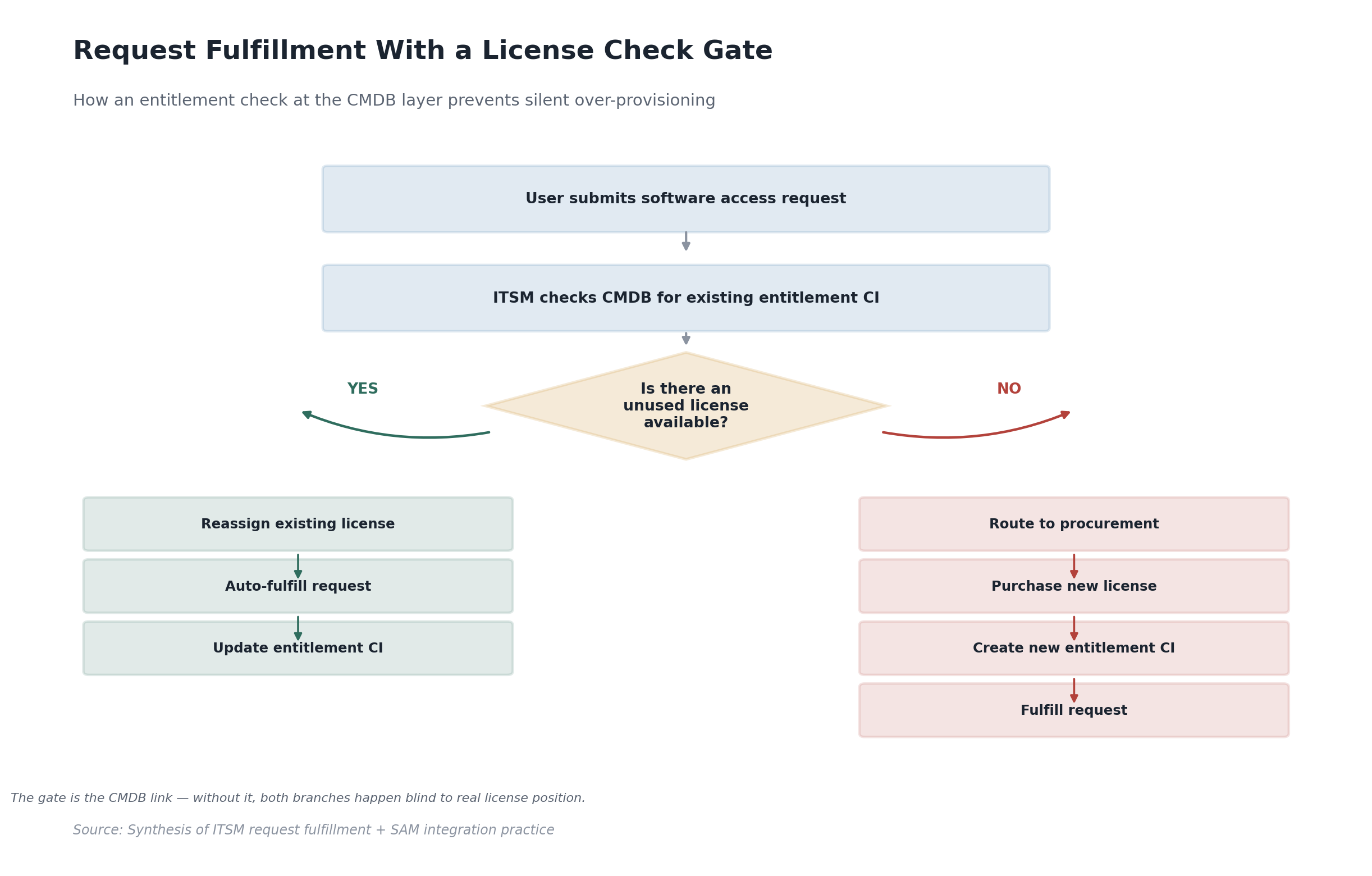
Getting software into the CMDB is only half the job. The value shows up when core ITSM processes start querying that data automatically instead of relying on someone remembering to check.
Change management is the clearest case. A change request to upgrade or replace an application should trigger an automatic look at what’s licensed against it — how many entitlements exist, whether the new version changes the licensing metric (per-core versus per-user, for instance, which is exactly the kind of change that quietly triggers a compliance gap), and whether the change affects a product tied to a vendor’s audit-sensitive terms. Without that check built into the workflow, license implications get discovered after the change ships, when the fix costs more and the leverage is gone.
Incident management benefits in a quieter but still real way. A responder working a P1 on a licensed application gains real context when the incident record surfaces entitlement and vendor support-tier information directly — whether the org is even entitled to file a vendor support ticket, what the support contract covers, and whether the incident is happening on a system running unlicensed or under-licensed software, which changes both the remediation path and who needs to be looped in.
Request fulfillment is where the automation pays for itself fastest. When someone requests a software license through the catalog, the fulfillment workflow should check available entitlement pool before routing anything to procurement. Plenty of organizations still buy a new seat every time someone asks, never checking whether a former employee’s seat sits reclaimed and idle. Zylo’s 2026 research pegs average license utilization at just 54% of purchased seats actually in use — up from 47% the year before, which is real progress, but it still means close to half of what’s been bought sits unused on any given day. A request workflow that checks the pool before buying anything closes a meaningful part of that gap automatically, without anyone having to run a reconciliation report.
The cumulative effect of wiring these three processes together is fewer surprises. Change goes out with license impact already known. Incidents get resolved with vendor and entitlement context instead of a follow-up email to procurement. Requests get fulfilled from existing inventory before anyone opens a purchase order. None of this requires exotic tooling — ServiceNow, BMC Helix, and Atlassian all support this kind of workflow logic natively once the underlying data model is sound. The platform isn’t the hard part.
Where This Breaks Down in Practice
Every organization that’s tried this integration runs into the same handful of failure modes, and it’s worth naming them plainly.
Stale CMDB data. A CMDB that isn’t refreshed through discovery or reconciliation drifts out of sync with reality within months, and once people stop trusting it, they stop using it — which accelerates the drift further. A license impact check run against a six-month-old CMDB snapshot is worse than no check at all, because it produces false confidence.
Duplicate CI records. Manual entry, multiple discovery tools reporting the same asset under different identifiers, and mergers or divestitures all produce duplicate CIs for the same underlying software or hardware. Duplicates split entitlement counts across records, which makes utilization numbers wrong in both directions — sometimes showing phantom shortages, sometimes hiding real over-deployment.
No agreed single source of truth. This is the one that undoes otherwise good integration work. If finance tracks entitlements in a procurement system, IT tracks installs through discovery, and the service desk tracks something else again, every automated check is really just asking one system’s opinion and treating it as fact. Somebody has to decide, formally, which system is authoritative for which data element — and everything else needs to sync to it or get deprecated.
None of these are exotic problems. They’re the ordinary cost of running configuration and asset data through processes that involve procurement, IT operations, and end users with different incentives. Fixing them isn’t glamorous work, but skipping it is exactly why so many SAM-CMDB integration projects stall out after the initial rollout looks good in a demo.
A Framework for Thinking About the Whole Thing
This is roughly the territory Desqcon’s AEIOU framework was built to cover — Automation, Edification, Integration, Operations, and User experience — as a way of keeping a SAM-CMDB-ITSM initiative honest about what it actually needs. Automation without clean integration just automates bad data faster. Integration without edification means nobody on the change or incident team understands why the license flag showed up, so they ignore it. Operations without a user experience lens produces a fulfillment process that’s technically correct and practically unusable, so people route around it. Working across ServiceNow, BMC Helix, and Atlassian environments, the pattern holds regardless of platform: the tooling rarely fails first — the operating model around it does, and vendor-neutral thinking helps because the fix usually isn’t a feature request, it’s a process and ownership decision.
Security incidents make the stakes concrete. Trend Micro’s April 2025 research attributed 74% of cybersecurity incidents to unknown or ungoverned assets — a category that includes plenty of software nobody in IT knew was running. A CMDB that’s actually current, tied into SAM and wired into ITSM workflows, is one of the more practical defenses against exactly that blind spot, alongside whatever the security team is doing separately.
Where to Start
None of this gets fixed by buying a new tool or running one more discovery scan. It gets fixed by being honest about where your CMDB, SAM, and ITSM data actually stand today — what’s connected, what’s duplicated, what nobody trusts anymore — and building a realistic plan from there. If you’re not sure how your organization’s integration maturity actually looks against peers, Desqcon runs SAM/CMDB integration maturity assessments across ServiceNow, BMC Helix, and Atlassian environments, vendor-neutral, with no assumption about which platform you should end up on. It’s a reasonable place to get an honest read before committing to a bigger integration project.