
Ask five people on a ServiceNow team what “the AI” actually does and you’ll get five different answers. One will say it writes incident summaries. Another swears it’s now closing tickets on its own. A third just renewed a Now Assist SKU and isn’t sure what changed when the vendor started talking about something called Otto. All three are half right, and the confusion isn’t really their fault — ServiceNow has shipped more AI branding in the last eighteen months than most platforms ship in a product lifecycle. Underneath the naming churn, though, there are exactly two different technologies doing the work, and they behave nothing alike.
This is the plain-language version: what generative AI and agentic AI actually do differently inside the Now Platform, what changed when ServiceNow folded Now Assist, Moveworks, and AI Experience into a single brand called Otto, and — the part that actually matters for planning a budget — who in your organization gets real value from each, and who’s still waiting on the hype to catch up to the product.
Two different technologies wearing one marketing umbrella
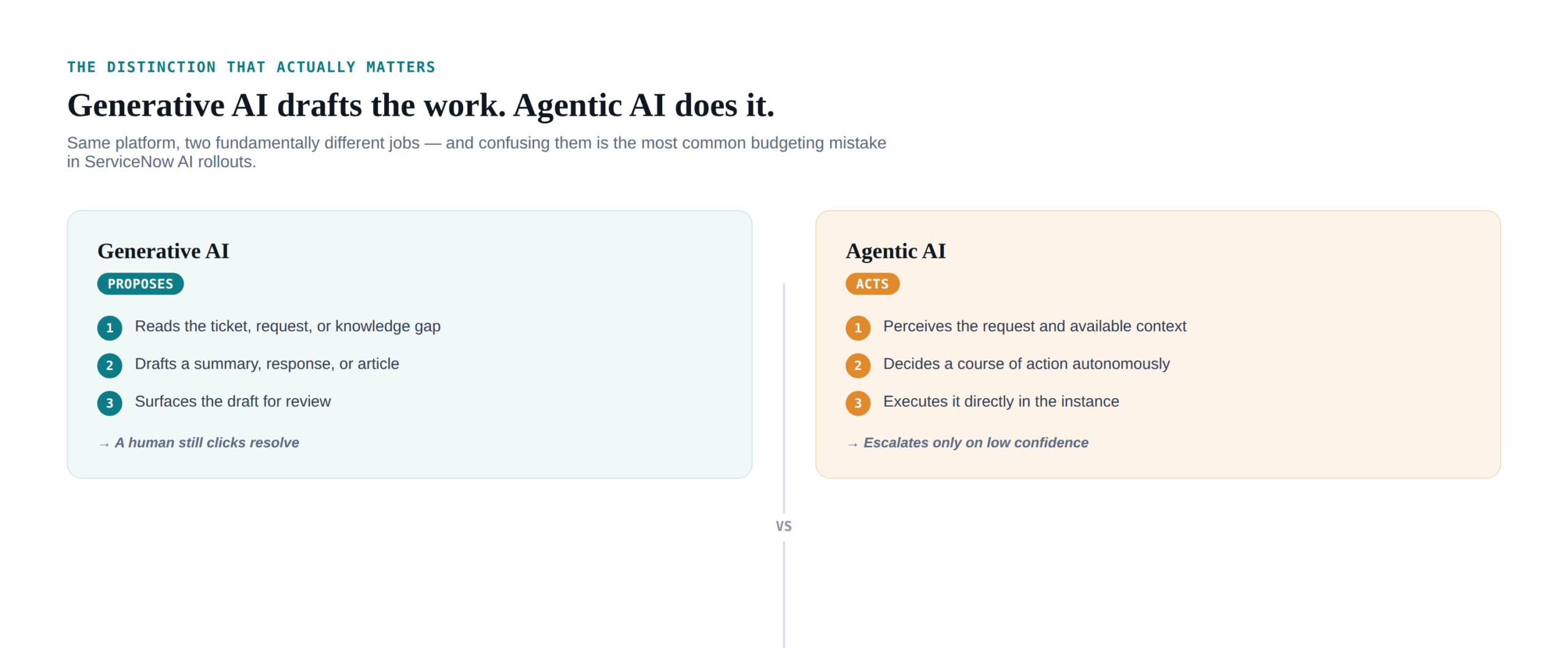
Generative AI, in the ServiceNow context, is fundamentally a drafting tool. Feed it a wall of incident notes and it writes a clean summary. Point it at a knowledge gap and it drafts an article. Ask it to write a customer-facing email and it produces a reasonable first pass. It’s genuinely useful, measurably fast, and — this is the part vendors gloss over — it never actually does anything to your instance. A human still reads the draft, still clicks resolve, still decides the ticket is actually fixed. Generative AI proposes; a person disposes.
Agentic AI is a different animal entirely. It’s built to take the action, not just suggest it — reading a ticket, deciding what needs to happen, executing the fix (resetting the password, reassigning the incident, kicking off a remediation script, updating the CMDB record), and only looping in a human when it hits something outside its authority or confidence threshold. The distinction that actually matters operationally: generative AI changes how fast your people work, agentic AI changes how much they have to touch in the first place. Conflating the two is how projects end up over-budgeted for the wrong capability — teams buy a chat assistant expecting ticket deflection, or buy autonomous agents expecting a drafting tool, and neither expectation survives contact with the actual SKU.
What actually changed when ServiceNow launched Otto
At Knowledge 2026, ServiceNow folded three previously separate AI surfaces — Now Assist, the Moveworks platform acquired for roughly $2.85 billion in early 2025, and the multimodal AI Experience layer — into a single assistant called ServiceNow Otto. If you’ve been running Now Assist skills in production, nothing you built breaks; AI Agent Studio and the agents already deployed there keep running exactly as configured. What changes is the intake layer sitting in front of all of it — one assistant surfaced consistently across Virtual Agent, Microsoft Teams, Slack, and Google Chat, instead of three differently-branded experiences depending on which product a request happened to route through.
The more consequential change is architectural, not cosmetic. ServiceNow describes the new foundation as a “Sense → Decide → Act → Secure” stack, and three pieces of it are worth knowing by name because they show up in every serious Otto conversation from here forward:
- Context Engine — grounds every response in what’s actually true in your specific instance, rather than a generic model’s best guess. This is the piece that’s supposed to stop an AI agent from confidently hallucinating a CMDB relationship that doesn’t exist.
- Workflow Data Fabric — pulls live data across a reported 350-plus connectors instead of relying on periodic, stale syncs. In practice this is what lets an agent reason about a Salesforce record and a ServiceNow incident in the same decision without a nightly ETL job standing between them.
- AI Control Tower — logs every action any AI agent takes anywhere in the environment, so “what did the AI actually do at 2am” has an answer that isn’t a shrug. This is also where model provider selection lives — Now LLM Service, Azure OpenAI, Google Gemini, or Anthropic’s Claude on AWS, depending on what your governance and data residency requirements allow.
Worth saying plainly: as of this writing, “Now Assist” and “Otto” are still both in active use in ServiceNow’s own materials and in most implementation partners’ vocabulary — the rebrand is recent enough that search traffic, documentation, and SKU names haven’t fully converged on one term. If you’re evaluating this for budget purposes, assume anything sold to you as “Now Assist” in the next few renewal cycles is functionally part of the same Otto architecture, and ask explicitly which stack — the older Now Assist skill model or the new Sense-Decide-Act layer — you’re actually being quoted for.
Who actually benefits — and who’s still waiting
The honest answer is that the benefit isn’t evenly distributed, and pretending otherwise is how AI rollouts lose credibility with the people who have to use them daily.
| Who | What actually changes for them |
|---|---|
| Service desk / L1-L2 agents | The biggest, fastest, least controversial win. Case summarization and drafted resolution notes save real minutes per ticket — not transformative on their own, but they compound across hundreds of tickets a week. |
| ITOM / SRE and ops engineers | Alert noise reduction and correlation are the genuine relief valve here; root cause analysis assistance is useful but still needs a skeptical human, especially in hybrid or legacy-heavy environments the model wasn’t trained on. |
| SAM / ITAM managers | Automated entitlement reconciliation and reclamation flag hard-dollar savings that used to take a consultant-led audit to surface. This is the quietest win in the whole portfolio and often the fastest to pay for itself. |
| Admins and platform developers | Faster to build and test AI Agent Studio flows now that Otto’s intake layer standardizes how requests arrive — but debugging an agent that reasoned its way to the wrong action is a genuinely new skill most teams haven’t hired for yet. |
| CIOs and IT leadership | Better instrumentation via AI Control Tower — finally a real answer to “what is our AI actually doing” for a board or auditor. The ROI story is real but immature; treat first-year projections skeptically. |
| End users / employees | Faster password resets, access requests, and routine fulfillment when it works — and a noticeably worse experience than a human agent when a request falls outside the agent’s trained scope and the handoff isn’t smooth. |
The benefits case, with the numbers that actually hold up
Vendor decks love round, flattering numbers. The figures below are the ones that show up consistently across independent benchmarking rather than a single case study, and they’re worth quoting with their caveats attached rather than as marketing absolutes.
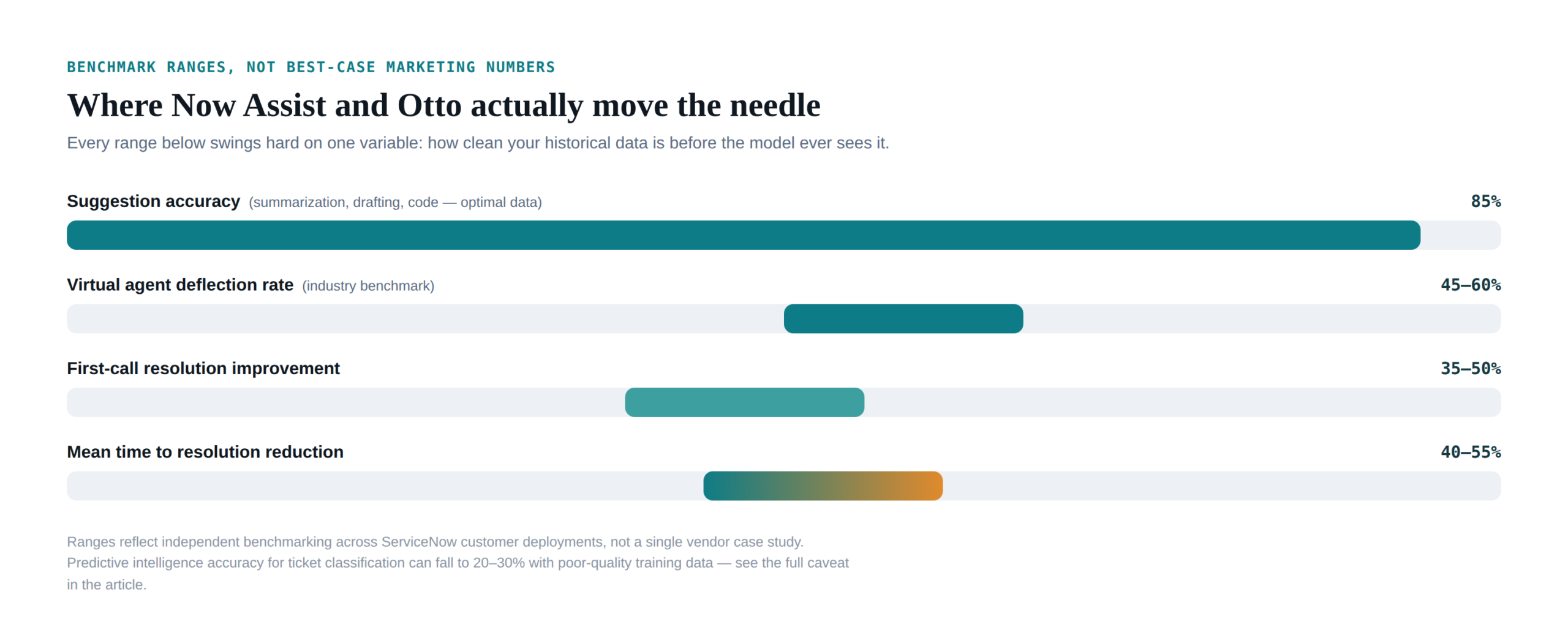
The number that should get more attention than it does: predictive intelligence accuracy for automatic ticket classification and routing drops to roughly 20-30 percent with poor-quality training data — a nearly three-to-one swing depending entirely on how clean your historical ticket data is before you ever turn the model on. That single caveat is worth more than any of the headline percentages above, because it’s the difference between an implementation that pays for itself in a quarter and one that quietly gets shelved after a disappointing pilot.
The adoption gap nobody’s SKU pitch mentions
Here’s the number that should temper any Otto or Now Assist rollout plan: industry-wide, roughly 80 percent of enterprise applications now ship with at least one embedded AI agent, but only about 31 percent of enterprises actually have an agent running in production. That’s not a ServiceNow-specific statistic, but it maps almost exactly onto what implementation partners report — pilots are easy to stand up and hard to graduate. Roughly 88 percent of agentic AI pilots across industries never make it to production, and the organizations that do succeed share one trait more than any other: someone senior is explicitly named as the accountable “AI agent owner,” a role that barely existed two years ago and now shows up in over half of enterprises with agents in production.
That’s the real lesson underneath the Otto rebrand: the technology getting more capable doesn’t automatically make an organization ready to run it unsupervised. Governance, a clean CMDB, and a named owner matter more to whether this pays off than which LLM provider you pick in AI Control Tower.
Not sure how ready your environment actually is for agentic AI? Our ITSM & ITOM Maturity Assessment scores people, process, tooling, and data quality against ITIL 4, SIAM, and IT4IT — the same gaps that quietly sink agentic AI pilots show up clearly in a maturity scorecard before you’ve spent a cent on licensing.
Frequently asked questions
Is Otto a new product I have to buy separately from Now Assist?
No — Otto is the unified experience layer sitting in front of capability you likely already license under Now Assist and AI Agent Studio. Existing agents and skills keep working; what’s new is the consolidated intake experience and the underlying Context Engine, Workflow Data Fabric, and AI Control Tower. Confirm with your account team exactly which architecture your current contract covers, since the rebrand rolled out mid-cycle for most customers.
Do we need agentic AI, or is generative AI enough for our use case?
If the goal is faster human work — better drafts, faster summaries, quicker knowledge capture — generative AI alone gets you most of the value with far less governance overhead. Reach for agentic AI specifically when the goal is reducing the number of human touches per request, and only after your underlying data (especially the CMDB) is clean enough to trust an autonomous action against it.
Which LLM provider should we pick in AI Control Tower?
There’s no universally correct answer — it depends on data residency requirements, existing enterprise agreements, and latency tolerance. Now LLM Service is the path of least friction for most customers; Azure OpenAI, Google Gemini, and Anthropic’s Claude on AWS are there specifically for organizations with existing commitments or compliance requirements that point elsewhere.
How long before an agentic AI pilot actually shows ROI?
Across enterprise agent deployments generally, median time-to-value sits around five months, with a wide spread by function — faster for narrow, well-scoped use cases, considerably slower for anything touching finance or operations workflows with more approval chains involved. Treat any vendor promise of ROI inside a single quarter with real skepticism.
