
For most of ITSM’s history, “automation” meant a workflow that ran the same five steps every time, in the same order, regardless of context. It was reliable precisely because it was rigid. Agentic AI breaks that assumption on purpose — it reasons about each request instead of following a fixed script, which is exactly what makes it more capable and exactly what makes it riskier to turn loose on a production instance. Nowhere is that trade-off more visible than in ITSM and ITOM, the two disciplines where ServiceNow’s agentic push is furthest along and where the gap between the pilot deck and the production reality is widest.
This is a module-by-module look at what’s actually changing — not the roadmap slide, the operational reality — plus the failure patterns that show up often enough to name specifically.
ITSM: from “the AI drafted a response” to “the AI closed the ticket”
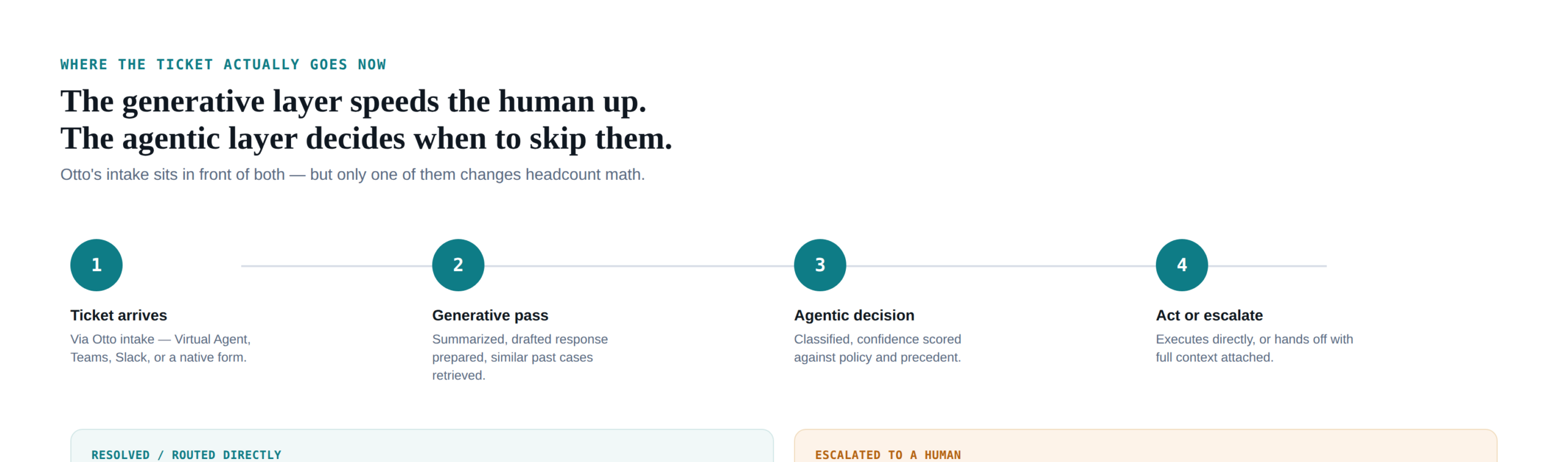
The first wave of Now Assist inside ITSM was entirely generative — summarize this incident, draft this resolution note, suggest this knowledge article. Useful, low-risk, and still exactly what most organizations are running today. The agentic layer sitting on top of it is a different proposition: instead of drafting a triage recommendation for a human to act on, an AI agent reads the incoming ticket, classifies it, checks it against similar historical incidents, and routes or resolves it directly — reserving the human touch for cases it isn’t confident about or isn’t authorized to close.
Where this shows up concretely inside ITSM today:
- Automated triage and routing. Incidents get classified and assigned without sitting in a dispatch queue. Deployments pairing this with a well-tuned agent layer report escalation-rate reductions in the range of 75-80 percent for high-volume queues — a number that sounds implausible until you consider how much of “triage” in most organizations is really just a human reading a ticket and applying a rule they could have written down years ago.
- Case and incident summarization. Still generative, not agentic, but worth restating because it’s the highest-confidence win in the entire portfolio — measured time savings in the range of 2.5 to 11 minutes per interaction depending on complexity, with essentially no governance risk since a human still reviews before acting.
- Proactive request fulfillment. Access requests, standard changes, and password resets increasingly resolve end-to-end without a human touch — BMO’s public case study cites a 200 percent year-over-year jump in self-service adoption after rolling this out, alongside roughly 50 percent deflection of routine tickets that used to need a live agent.
ITOM: where “self-healing” stops being a buzzword
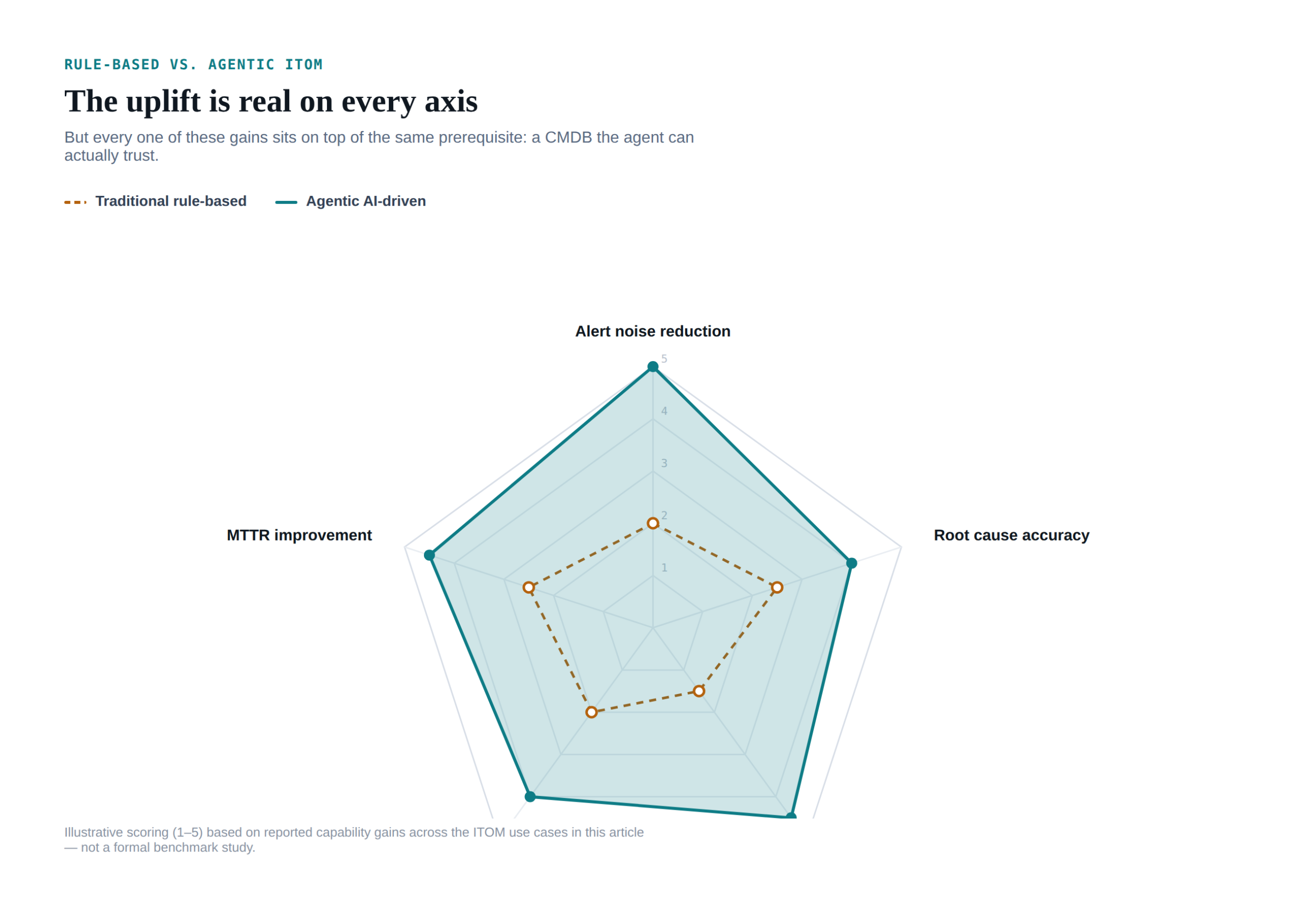
ITOM is arguably where agentic AI has the clearest, least controversial case, because the discipline was already built around correlation and pattern-matching — agentic reasoning is a natural extension of what event management was trying to do with static rules for a decade. The eleven use cases below aren’t hypothetical; they map to features ServiceNow and its implementation partners are actively shipping against real ITOM instances right now.
| Capability | What it actually does |
|---|---|
| Event noise elimination | Suppresses low-value alerts algorithmically so the team’s attention goes to what’s actually critical, not what’s simply loud. |
| Alert correlation | Groups related alerts into a single incident with shared context instead of five separate tickets nobody connects until a human notices the pattern. |
| Autonomous root cause analysis | Reasons through likely causes faster than a manual trace — genuinely useful, but still needs a skeptical senior engineer signing off in anything but the most routine cases. |
| Predictive outage prevention | Flags impending failures from leading indicators and can trigger preventive action before users notice anything. |
| Business impact prioritization | Ranks incidents by actual revenue or service criticality rather than whoever escalated loudest. |
| Self-healing execution | Runs the remediation directly — restarting a service, scaling a resource — without waiting on an on-call page. |
| Change-risk assessment | Scores a proposed change’s failure risk before implementation, using patterns from past changes that went sideways. |
| Capacity forecasting | Recommends scaling ahead of demand instead of reacting to a threshold breach after the fact. |
Where this actually breaks — the failure patterns worth naming
It would be dishonest to write this up without the failure side, because agentic ITSM/ITOM rollouts fail often enough that the pattern is now well-documented, not anecdotal. Three causes show up repeatedly:
- An incomplete or stale CMDB. An agent executing autonomous remediation against wrong or missing configuration data doesn’t just make a bad recommendation — it runs a script against the wrong server, or assigns an incident to a team that doesn’t own the actual failing component. This is the single most common root cause behind a stalled agentic rollout.
- Context loss past roughly ten interaction turns. Multi-turn diagnostic conversations are where current-generation agents most reliably lose the thread — the reasoning chain degrades and the agent’s confidence in a wrong conclusion doesn’t drop the way you’d want it to.
- Probabilistic reasoning colliding with deterministic legacy logic. An LLM-driven agent’s output is inherently probabilistic; a lot of the automation it’s now sitting on top of was built on rigid, deterministic rules. When the two disagree, the result is often a silent failure or a duplicated process rather than a clean error a human would immediately notice.
Put together, these are consistent enough that industry reporting puts the overall agentic platform failure rate — meaning deployments requiring significant rework or outright abandonment — at roughly 45 percent. That’s not a reason to avoid the technology. It’s a reason to sequence the rollout correctly instead of turning autonomous remediation loose on day one.
What actually separates the wins from the failures
The organizations getting real value out of agentic ITSM and ITOM almost always did three things before flipping on autonomous execution: they cleaned and validated the CMDB first — not “eventually,” first — they started with read-only or recommend-only agent modes and graduated to autonomous action deliberately, and they named a specific, accountable owner for what the agents are allowed to do rather than leaving governance as a shared, unowned responsibility. None of that is exciting to put in a project plan. It’s also the difference between the 12 percent of pilots that graduate to production and the 88 percent that don’t.
Before turning on autonomous remediation, know where your ITSM and ITOM program actually stands. Our ITSM & ITOM Maturity Assessment benchmarks people, process, tooling, and — critically for agentic AI — data quality, so you know exactly which gaps to close before an agent is making decisions against your CMDB unsupervised.
Frequently asked questions
Should we start with ITSM or ITOM agentic AI first?
ITSM generally has the lower-risk entry point — summarization and drafted responses carry almost no governance exposure, and even agentic triage/routing is easier to roll back than autonomous ITOM remediation. Most organizations we work with sequence ITSM’s generative layer first, ITSM agentic triage second, and ITOM self-healing only after both are stable and the CMDB has been validated.
How clean does our CMDB actually need to be before we enable self-healing?
There’s no universal threshold, but as a practical floor: every configuration item an agent might act on needs an accurate, current owner, relationship map, and criticality rating. If you can’t confidently answer “what does this depend on and who owns it” for a given CI, that CI isn’t ready for autonomous remediation yet — keep it in recommend-only mode.
What’s a realistic timeline to go from pilot to production?
Plan in phases rather than a single date: a foundational pilot on a narrow, well-understood use case, then expanded integration once that pilot proves out, then broader autonomous scope — typically six months or more end to end for anything beyond a single narrow use case. Compressing this timeline is the most common reason pilots end up in the 88 percent that don’t graduate.
Does agentic AI replace our ITOM or NOC team?
In our experience, no — it changes the shape of the work more than the headcount. Routine noise suppression and correlation free engineers from alert-fatigue busywork, but root cause analysis on anything genuinely novel, and every autonomous action above a conservative risk threshold, still needs a human who understands the environment well enough to catch the agent being confidently wrong.
