
Type “how to become a ServiceNow admin” into any search bar and you’ll land on the same three letters over and over: CSA. The Certified System Administrator exam is the front door to the entire ServiceNow ecosystem — the one credential nearly every admin, aspiring developer, and business analyst on the platform holds before anything else. It’s also one of the most-searched ServiceNow terms on desqcon’s own site, and for good reason: it’s the certification that actually gets people hired, not just the one that looks good on a slide.
This is the study guide we wish existed when we first sat the exam — what’s actually on it, what it costs, how long to prepare, and where CSA fits into the rest of a ServiceNow career. No affiliate fluff, no recycled marketing copy from ServiceNow’s own product pages.
What the CSA certification actually is
CSA is ServiceNow’s foundational, vendor-issued credential covering platform navigation, configuration, and day-to-day administration — the skills needed to keep an instance running, not build one from scratch. There’s no formal prerequisite to sit it, but showing up with zero hands-on time on the platform is a common way to fail; most successful candidates have somewhere between three and six months of real instance experience, whether from a job, an internship, or deliberate practice on a free developer instance, before they attempt it.
It matters beyond the credential itself because ServiceNow has built its entire certification ladder on top of it. CSA isn’t just a starting point — for most people it’s the starting point, and increasingly a hard prerequisite for what comes next.
Exam format, cost, and logistics
The exam runs about 60 multiple-choice and multiple-select questions in 90 minutes, delivered proctored through ServiceNow’s Webassessor testing platform — either at a test center or online with a live proctor watching over webcam. ServiceNow doesn’t publish an exact passing percentage, but third-party prep guides and community discussion consistently put the practical bar somewhere around 65–70% correct.
Pricing varies by region and has shifted over the past couple of years, so treat this as a planning range rather than a fixed number: a first attempt typically runs in the $150–$300 range depending on country of residence and current promotions, with a discounted retake fee (commonly cited around $100) if you don’t pass the first time. ServiceNow allows a limited number of retakes — budget for the possibility you won’t pass on attempt one, because a meaningful share of candidates don’t.
What’s actually on the exam
ServiceNow publishes an official exam blueprint broken into six learning domains, and the weighting tells you exactly where to spend your study time. Database management and security is consistently the heaviest single domain — nearly a third of the exam — which surprises candidates who assume CSA is mostly about the UI.
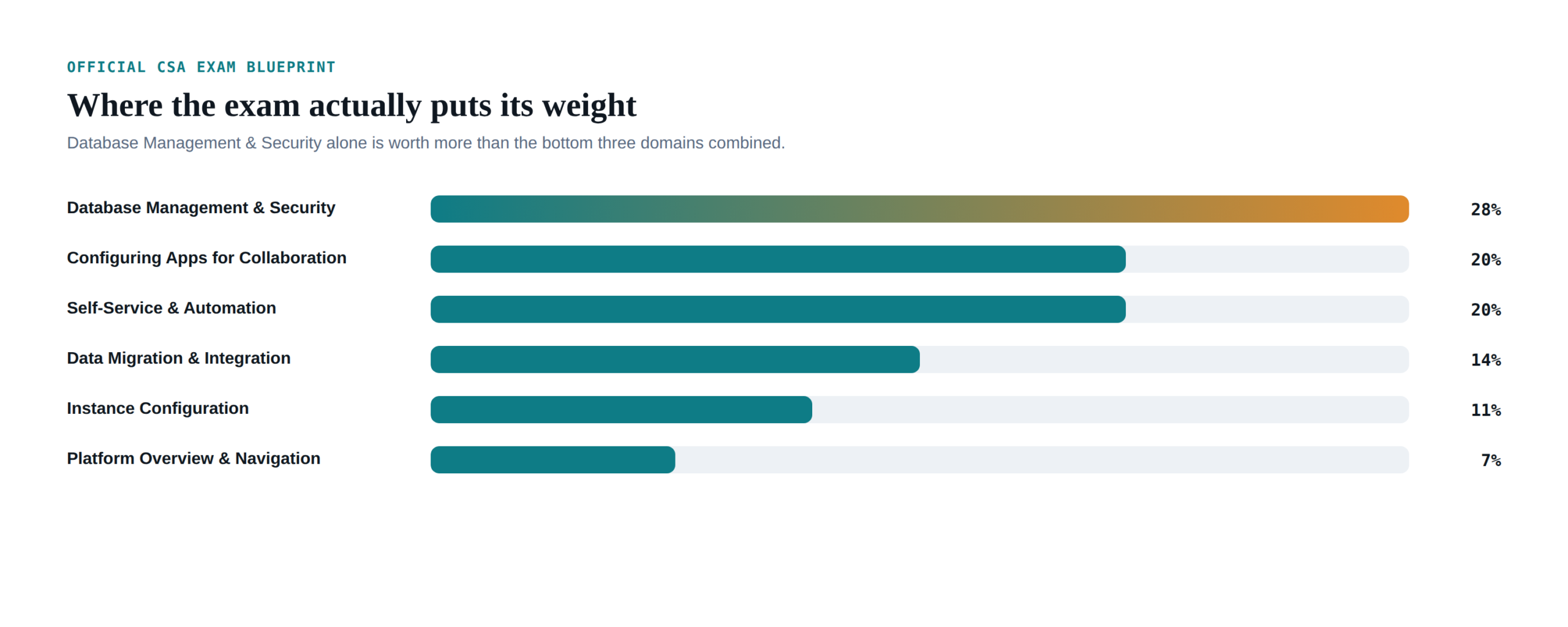
| Domain | Weight | Covers |
|---|---|---|
| Database Management & Security | ~28% | Tables, fields, relationships, ACLs, roles, data policies, CMDB structure |
| Configuring Apps for Collaboration | ~20% | UI Builder/UI policies, forms, lists, notifications, knowledge management |
| Self-Service & Automation | ~20% | Service catalog, workflow/flow designer, business rules, SLAs |
| Data Migration & Integration | ~14% | Import sets, transform maps, web services, REST/SOAP basics |
| Instance Configuration | ~11% | System properties, update sets, scheduled jobs, instance maintenance |
| Platform Overview & Navigation | ~7% | UI navigation, application menus, core platform concepts |
Two domains — Database Management and the combined 40% covered by Collaboration and Self-Service/Automation — make up roughly two-thirds of the exam between them. If your study time is limited, that’s where it should concentrate first.
How to actually study for it
ServiceNow’s own resources are genuinely good here, and skipping them in favor of third-party dumps is the single most common way candidates waste study time:
- The “Administration Fundamentals” on-demand course on Now Learning/ServiceNow University, plus the dedicated CSA learning path and certification-prep module built specifically around the exam blueprint.
- A free Personal Developer Instance (PDI), requested through ServiceNow’s developer site — this is non-negotiable. Reading about ACLs and actually breaking one, then fixing it, are completely different levels of retention, and the exam rewards the second one.
- ServiceNow Community forums for scenario-style questions and real practitioners’ study notes — official, but crowd-sourced, so cross-check anything that looks outdated.
On timeline: there’s no single official number, but candidates coming in with existing hands-on exposure typically describe a focused final stretch of several weeks — building out practice scenarios on a PDI, reviewing the blueprint domain by domain, and taking practice questions in the exam’s actual time pressure — rather than months of passive reading. Candidates starting from genuinely zero platform exposure should expect to need meaningfully longer, closer to a couple of months of consistent practice.
Where CSA fits in the certification path
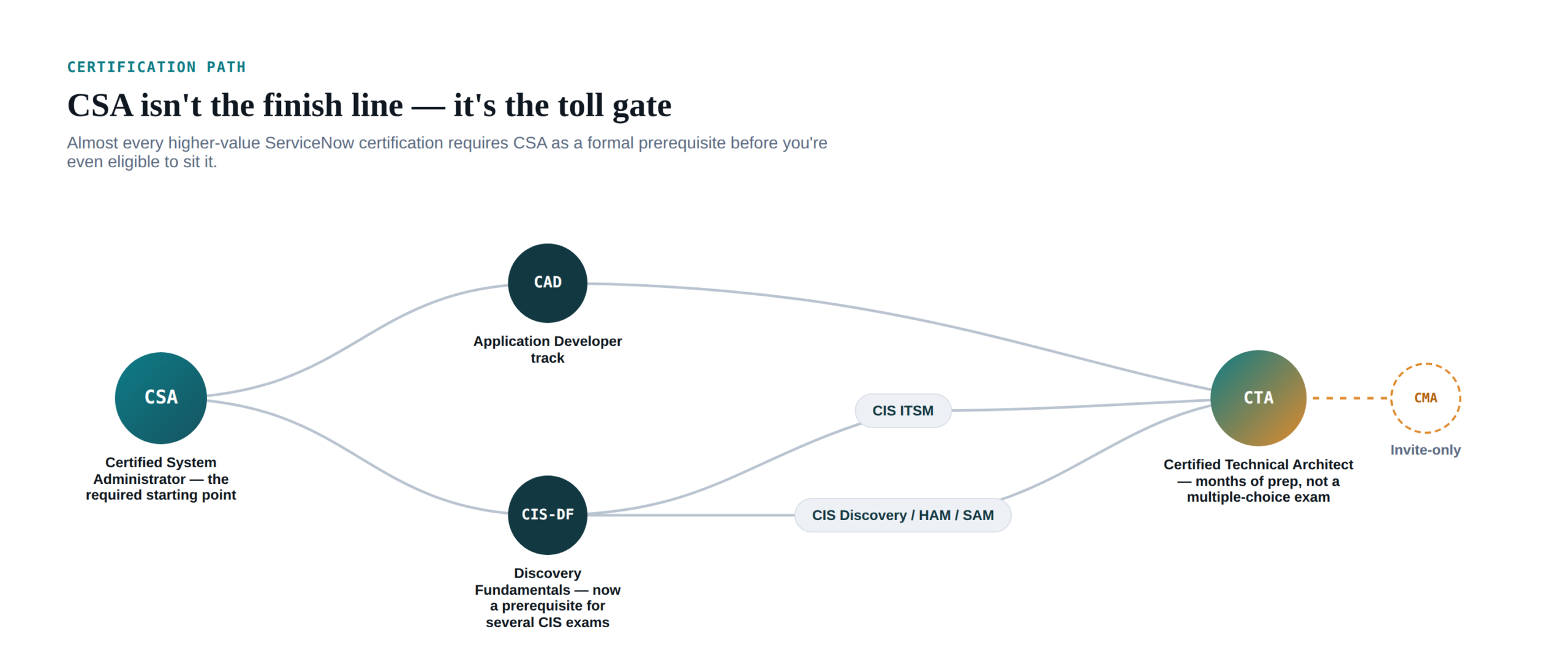
CSA is the mandatory foundation for essentially every certification ServiceNow offers past entry level. From there, the path typically splits two ways: toward CAD (Certified Application Developer) for people moving into building custom applications on the platform, or toward the CIS (Certified Implementation Specialist) track for people specializing in a specific product line — ITSM, HR Service Delivery, Discovery, Software Asset Management, and others. ServiceNow has been tightening this track: several CIS specializations now require CIS-Discovery Fundamentals as a formal prerequisite before you can sit the specialization exam itself, so check the current prerequisite chain for your target specialization before assuming CSA alone unlocks it.
At the top of the ladder sits CTA (Certified Technical Architect) — a program measured in thousands of dollars and months of preparation, not a multiple-choice exam — and above that, an invite-only CMA (Certified Master Architect) tier. Realistically, almost nobody starts planning for CTA on day one; CSA is what gets you in the door, and the specialization you pick afterward is usually driven by what your employer (or the job market) actually needs.
Is it worth it?
ServiceNow administration is one of the more resilient IT career paths right now, for a straightforward reason: the platform keeps expanding into more of the enterprise (ITSM, HR, security, now AI-agent orchestration through ServiceNow’s “Now Assist” tooling on the current Zurich release), and every expansion needs administrators who understand the underlying data model, not just a specific module. Reported administrator salaries vary widely by region, seniority, and whether the role is pure admin versus admin-plus-development, but self-reported compensation trackers consistently place experienced ServiceNow admins well above general IT support pay — and CSA is the credential that gets a resume past the initial filter for those roles in the first place.
The honest caveat: CSA alone won’t get you a senior role or a six-figure salary. What it does is prove baseline platform competence to a hiring manager who has no other way to verify it, and unlock the specialization certifications that do move compensation meaningfully. Treat it as a gate you need to pass through quickly and well, not a destination.
Frequently asked questions
Do I need any prior certification to sit the CSA exam?
No formal prerequisite exists. In practice, some hands-on platform exposure — a job, internship, or deliberate PDI practice — makes the difference between passing and failing far more than any prior credential does.
How many questions are on the CSA exam, and how long do I have?
Approximately 60 multiple-choice and multiple-select questions, with a 90-minute time limit, delivered proctored via Webassessor.
What happens if I fail the CSA exam?
You can retake it for a discounted fee, typically well below the cost of a first attempt, up to a limited number of retries. Review your weakest blueprint domains before retaking rather than just repeating the same study material.
Is CSA still required if I only want to be a developer, not an admin?
Yes, in practice. CAD (the developer credential) assumes CSA-level platform knowledge, and most learning paths and employers expect CSA first regardless of which specialization you’re ultimately headed toward.
How is the CSA exam different from a CIS specialization exam?
CSA tests general platform administration — navigation, data model, security, basic automation — across the whole instance. CIS exams test deep configuration knowledge of one specific product line (ITSM, HR, Discovery, and so on) and generally require CSA, and sometimes an additional prerequisite like CIS-Discovery Fundamentals, before you’re eligible to sit them.
desqcon’s own ServiceNow CSA course is built directly around the current exam blueprint, with hands-on PDI labs for every domain above — a practical option if you’d rather train with structured labs than piece together a study plan from forum posts. And once CSA is done, our ServiceNow certification path guide can help you map out which specialization to chase next.
