
Nobody puts Software Asset Management on a keynote slide. There’s no self-healing server, no dramatic incident resolved in seconds — just entitlements, usage logs, and renewal dates in a spreadsheet somewhere. That’s precisely why it’s the least-discussed and most immediately profitable place AI has landed inside ServiceNow. Get an agentic reconciliation pass right and the savings show up as a specific, defensible number in the very first audit cycle — not a projected efficiency gain eighteen months out, an actual reduction in what you’re about to pay a publisher.
Here’s what AI-driven SAM actually does today, who in the organization feels it first, and — because this space has its own blind spots — where it still needs a human who understands the contract, not just the data.
What AI-driven SAM actually automates
Traditional SAM has always had the data; what it lacked was the time to act on it continuously. Reconciling entitlements against actual usage, flagging unused seats, and catching non-compliant installs were things a SAM analyst did during a scramble before a vendor audit, not a standing weekly practice. That’s the specific gap AI closes — not new insight so much as the same insight, running continuously instead of quarterly.
- Entitlement-to-usage reconciliation, running continuously. Instead of a point-in-time audit, the comparison between what you’ve licensed and what’s actually installed or logged in runs on an ongoing basis, surfacing drift before it becomes a compliance gap.
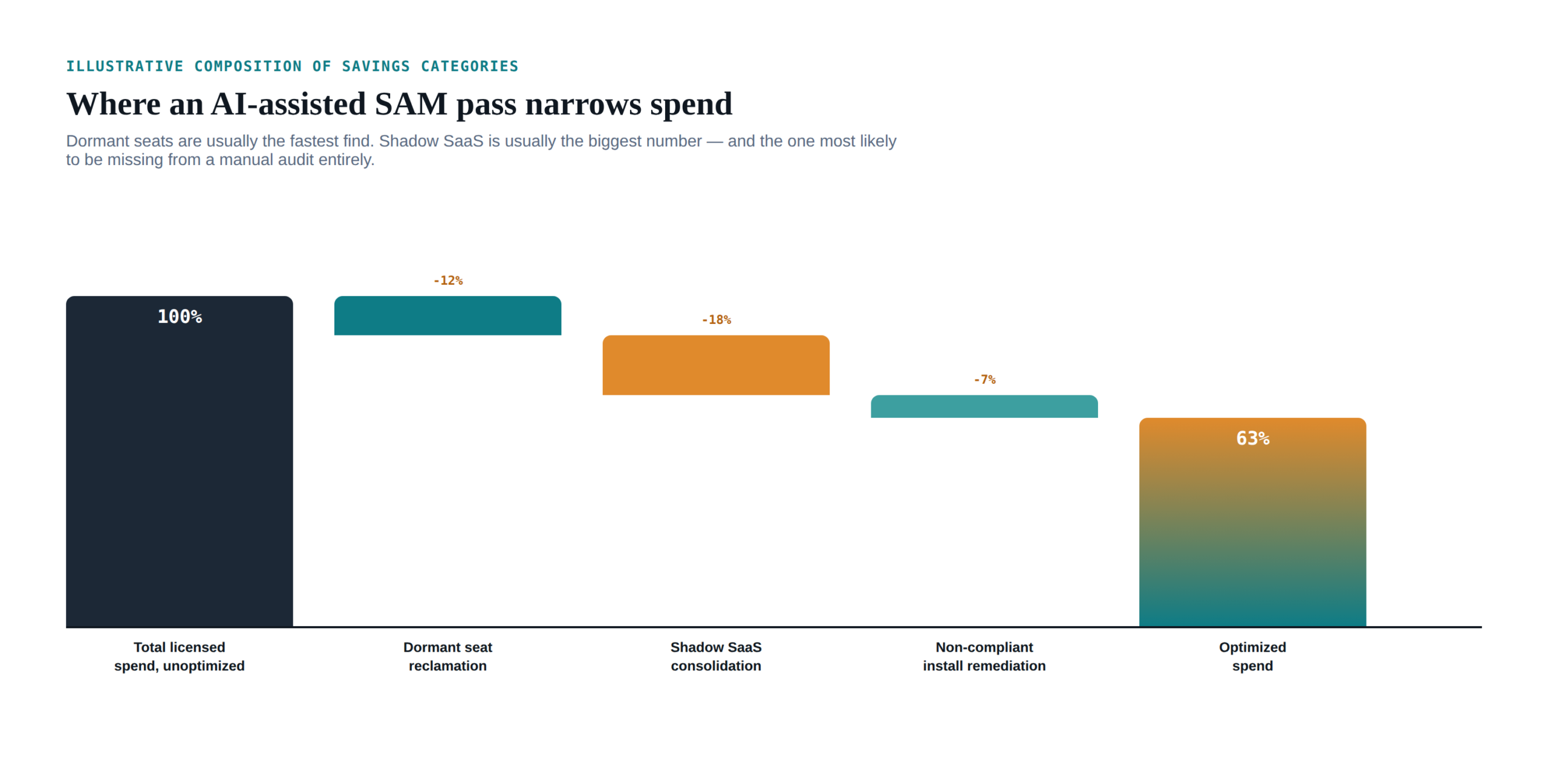
- Automated license reclamation and reharvesting. Dormant or underused seats — the classic example being a named-user license nobody’s touched in ninety days — get flagged and, in mature deployments, reassigned or reclaimed automatically instead of sitting on the books as a silent renewal.
- Shadow SaaS discovery. Expense reports, SSO logs, and network traffic get cross-referenced to surface SaaS spend that never went through procurement — routinely the single largest surprise line item in a first AI-assisted SAM pass.
- Audit-readiness scoring. Instead of a fire drill when a publisher’s audit letter arrives, compliance posture is visible on an ongoing basis, with the specific gaps that would show up in an audit flagged well before anyone outside IT asks.
- Natural-language spend queries. “How many unused Adobe seats do we have in EMEA” becomes a question a procurement lead can ask directly instead of a ticket that sits in a SAM analyst’s queue for a week.
Publicly reported deployments of this pattern describe “immediate hard-dollar savings in the first audit cycle” — language that’s notably more concrete than most AI ROI claims, and worth taking seriously specifically because it’s concrete. This isn’t a productivity multiplier that’s hard to measure; it’s a line item in a renewal negotiation that either shrinks or doesn’t.
Who actually feels this first
| Who | What changes for them |
|---|---|
| SAM / ITAM managers | Go from running a quarterly audit scramble to monitoring a continuously-current compliance and utilization picture — the job shifts from data-gathering to decision-making. |
| Procurement | Walks into a renewal negotiation with actual current utilization data instead of the vendor’s own usage report, which is a materially different negotiating position. |
| CFOs and finance leadership | Get a software spend number that’s defensible and current rather than reconstructed once a year — and a specific, attributable savings figure to report rather than a vague efficiency narrative. |
| Security teams | Shadow SaaS discovery is as much a security win as a financial one — an unsanctioned app nobody in IT knew existed is a data-governance risk long before it’s a budget line. |
| Compliance / audit-readiness owners | Trade a stressful, once-a-year fire drill for an ongoing posture check — the difference between reacting to an audit letter and already knowing the answer when it arrives. |
Why this doesn’t work in isolation — the CMDB connection
AI-driven SAM is only as good as the configuration data it’s reconciling against, which is the exact reason SAM, CMDB, and ITSM data can’t stay in separate silos the way they historically have. Software installed on an asset the CMDB doesn’t know about is invisible to a reconciliation pass no matter how good the AI is; an application relationship the CMDB has wrong produces a compliance gap that looks like a false positive until someone manually checks it. We’ve written specifically about closing that software blind spot, and it’s worth reading before investing heavily in AI-driven reconciliation — the AI amplifies whatever data quality you already have, in both directions. The same CMDB dependency shows up on the operations side too, which we cover in how agentic AI is changing ITSM and ITOM.
Where AI still needs a human in SAM
The reconciliation math is where AI earns its keep; contract interpretation is where it still needs supervision. Publisher licensing terms are deliberately, sometimes maddeningly, non-standard — a “named user” definition, a virtualization clause, or a bundled-suite entitlement can vary meaningfully between vendors and even between contract versions with the same vendor. An AI system can flag “this looks like an anomaly” reliably; deciding whether that anomaly is actually a compliance violation or a contractually permitted edge case still requires someone who’s read the actual agreement. Treat automated flags as a prioritized worklist, not a final verdict — especially before any renewal or true-up conversation with the publisher.
Getting started without a costly false start
The organizations that see the “hard-dollar savings in the first cycle” outcome almost always start the same way: they run a full entitlement-and-usage reconciliation before touching automated reclamation, so the AI’s first pass isn’t reclaiming a seat someone actually needs for a seasonal role. They prioritize their highest-spend publishers first rather than trying to reconcile the entire software estate simultaneously. And they treat the first ninety days of flagged anomalies as a review list, not an auto-pilot action list, until the false-positive rate on their specific environment is well understood.
Not sure how mature your SAM program actually is before layering AI on top of it? Our ITSM & ITOM Maturity Assessment benchmarks the underlying people, process, tooling, and data quality — the exact factors that determine whether an AI-assisted SAM rollout finds real savings or just automates existing blind spots faster.
Frequently asked questions
How fast does AI-driven SAM actually pay for itself?
Faster than most AI initiatives, because the savings are a direct spend reduction rather than an efficiency gain that has to be translated into dollars. Organizations with reasonably clean baseline data commonly see recoverable spend identified within the first reconciliation cycle — often the first quarter — though the exact figure depends heavily on how much shadow SaaS and dormant licensing has accumulated beforehand.
Can AI reclaim licenses automatically, or does a person need to approve it?
Technically, yes, it can be fully automated — but we’d recommend against starting there. Begin with AI flagging candidates for review, confirm the false-positive rate is low for your environment over a full quarter, and only then move genuinely low-risk categories (a seat with zero logins in 90+ days, for example) to automatic reclamation.
Does this replace our SAM analyst or consulting partner?
No — it changes what they spend time on. The manual data-gathering and reconciliation work shrinks dramatically; the judgment calls around contract interpretation, publisher negotiation, and deciding what to do about a flagged anomaly still need a person who understands both the data and the actual agreement.
What’s the biggest blind spot in AI-driven SAM?
Shadow SaaS that never touches a managed device or corporate SSO at all — a team paying for a tool on a personal card and expensing it. AI reconciliation against your CMDB and identity logs catches a lot, but not spend that never generates a digital footprint in a system you’re already monitoring.
