
Type “itil5” into Google and you’ll get two kinds of results: training providers insisting it’s the biggest thing to happen to IT service management in a decade, and forum threads from people asking whether it’s even real or just a typo for “ITIL 4.” Both reactions are understandable. PeopleCert doesn’t do soft launches, and the last time the framework changed this much — the ITIL 3 to ITIL 4 jump in 2019 — it took most of the industry a year to stop arguing about it.
So here’s the direct answer: ITIL (Version 5) is real. It’s not a rumor, not a rebrand, and not a typo. PeopleCert officially opened Foundation-level training and examination on February 2, 2026, with Bridge modules for existing ITIL 4 holders released alongside it. Advanced-level modules — Transformation, Strategy, Product, Service, Experience — began rolling out through Q2 2026. And there’s a hard deadline attached: every ITIL 4 module is scheduled to sunset on December 31, 2027, which is the part most of the “is this real” confusion tends to resolve once people see it.
This piece is the plain-language version of what changed, what didn’t, what it costs, and — the question everyone actually wants answered — whether you should get ITIL 4 or ITIL 5 right now.
What actually changed in ITIL 5
The honest summary is that ITIL 5 is an extension of ITIL 4’s architecture, not a demolition of it. If you’ve spent any time inside the Service Value System, you’ll recognize most of the furniture. But three changes are substantial enough that they change how the framework is positioned and used.
1. It’s no longer just about “IT services”
ITIL 4 was framed around IT service management. ITIL 5 widens that lens to digital product and service management — explicitly bringing product thinking (roadmaps, product owners, lifecycle economics) into a framework that used to speak almost exclusively in service terms. PeopleCert’s own positioning describes this as a shift from the “Fourth Industrial Revolution” framing of ITIL 4 to an “Industry 5.0” framing for Version 5, where AI-augmented, human-AI collaborative work is assumed rather than bolted on.
2. The core model has a new name and shape
The Service Value Chain — the six-activity engine (Plan, Improve, Engage, Design & Transition, Obtain/Build, Deliver & Support) that sat at the center of every ITIL 4 diagram — is replaced by the Digital Product and Service Lifecycle Model (PSLM). The Service Value System itself is renamed the ITIL Value System, with a revised visualization. Management practices are regrouped too: the old three-way split of General, Service, and Technical Management practices collapses into two categories, Product/Service Management and General Management.
3. AI gets its own layer of the framework
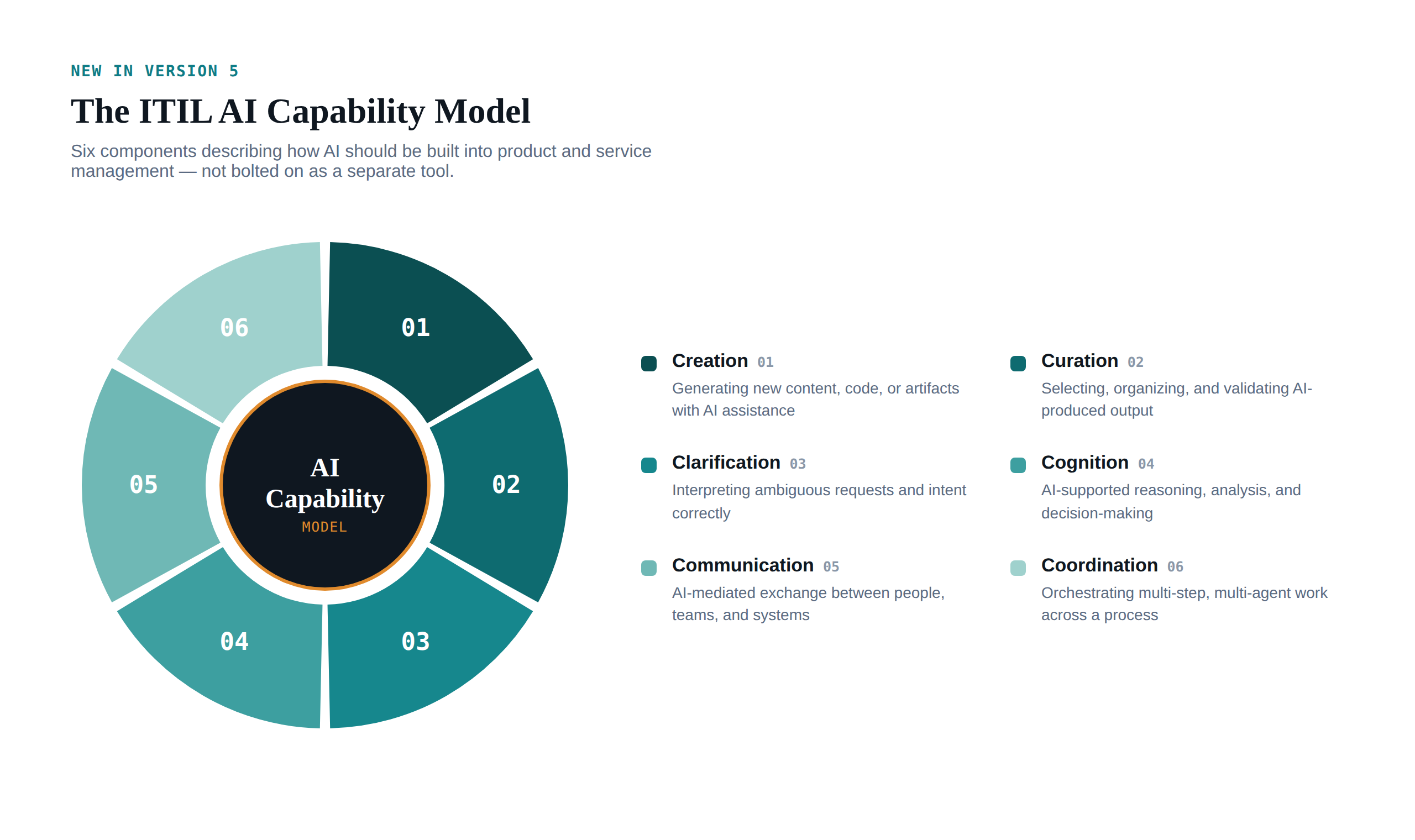
This is the most genuinely new material. ITIL 5 introduces the ITIL AI Capability Model, built around six components — creation, curation, clarification, cognition, communication, and coordination — describing how AI capability should be built into an organization’s service and product management, not just used as a point tool. There’s a new dedicated AI Governance publication, and “Organizations, people, and AI” is now explicitly named as a dimension consideration, extending the familiar Four Dimensions model.
What stayed exactly the same
This is the part that should make current ITIL 4 holders relax slightly. PeopleCert kept the load-bearing walls:
- All 34 management practices keep their ITIL 4 names. Incident Management, Change Enablement, Problem Management — nothing here got renamed or restructured.
- The seven guiding principles are unchanged — “focus on value,” “start where you are,” “collaborate and promote visibility,” and the rest carry over word for word.
- The Four Dimensions model continues, with a visualization update rather than a conceptual one.
- Core Service Value System components persist — governance, the practices, and continual improvement are still the backbone, just reorganized under the new ITIL Value System name.
In practice, this means an ITIL 4 Foundation holder isn’t starting from zero. It’s closer to a major version upgrade than a rewrite: the vocabulary for individual practices barely moves, but the model connecting them, and the assumptions about AI and product thinking layered on top, are genuinely new.
The version history, for context
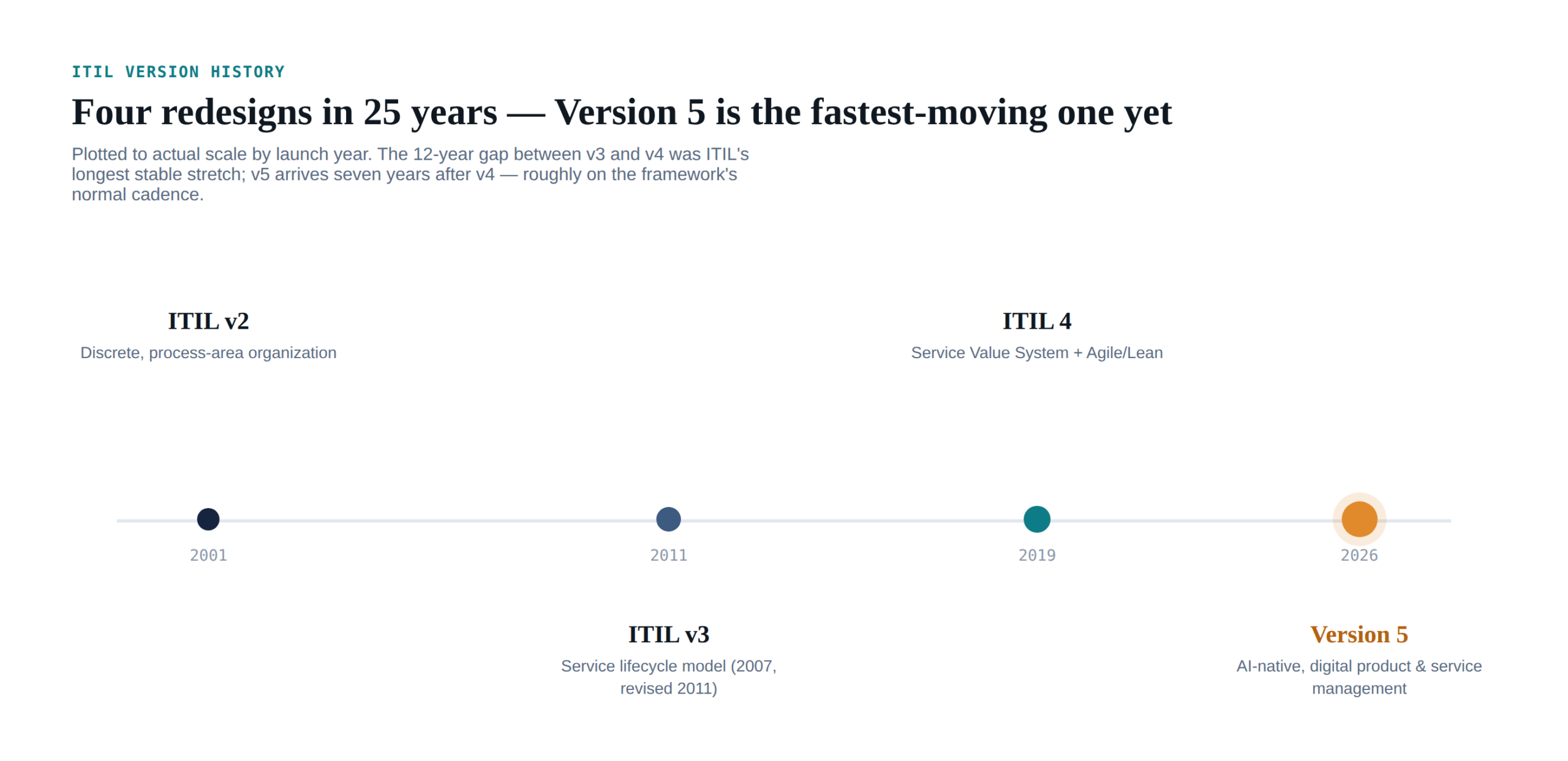
ITIL has never stayed still for long. Version 2 (2001) organized the framework around discrete process areas. Version 3 (2007, revised 2011) introduced the service lifecycle — Strategy, Design, Transition, Operation, Continual Improvement — that a lot of practitioners still think in by default. ITIL 4 (2019) replaced the lifecycle with the Service Value System and folded in Agile and Lean thinking. Five to seven years is the framework’s normal cadence between major redesigns, so Version 5 arriving in early 2026, seven years after ITIL 4, is roughly on schedule rather than early.
Your transition path, if you’re already ITIL 4 certified
PeopleCert built specific bridge routes rather than forcing a full retake, and which one applies to you depends on your current level:
| If you currently hold | Your route to ITIL 5 | Typical effort |
|---|---|---|
| ITIL 4 Foundation | No retake required. Progress directly into higher-level Version 5 modules, or take the optional one-day Bridge course first for context. | 0–1 day |
| ITIL 4 Managing Professional or Master | ITIL Managing Professional Transition (Version 5) module | ~5 days, versus 8–12 days via the full new route |
| ITIL 4 Practice Manager or Strategic Leader | ITIL Transformation (Version 5) module, required for the Version 5 designation upgrade | Single exam/module |
The practical upshot: nobody holding an ITIL 4 credential is starting over, and PeopleCert has explicitly said ITIL 4 credentials remain valid — there’s no forced re-certification for people who already hold one. What the sunset date affects is new enrollment: after December 31, 2027, you won’t be able to sit a fresh ITIL 4 exam at all, only ITIL 5.
Cost and exam format
ITIL 5 Foundation follows the same closed-book, multiple-choice format practitioners already know: 40 questions in 60 minutes, with a 65% pass mark (26 of 40 correct), delivered web-proctored or at a test center. Higher-level modules — Product, Service, Experience, Strategy, Transformation — move to an open-book format, a change from how several ITIL 4 higher-level exams were structured.
On price, PeopleCert’s exam voucher itself typically runs $350–$550 depending on country of residence, with training bundled in most accredited packages pushing the realistic total to somewhere in the $350–$800 range. That’s consistent with what ITIL 4 Foundation has cost over the last few years — Version 5 isn’t launching at a premium over its predecessor.
The December 2027 deadline, visualized
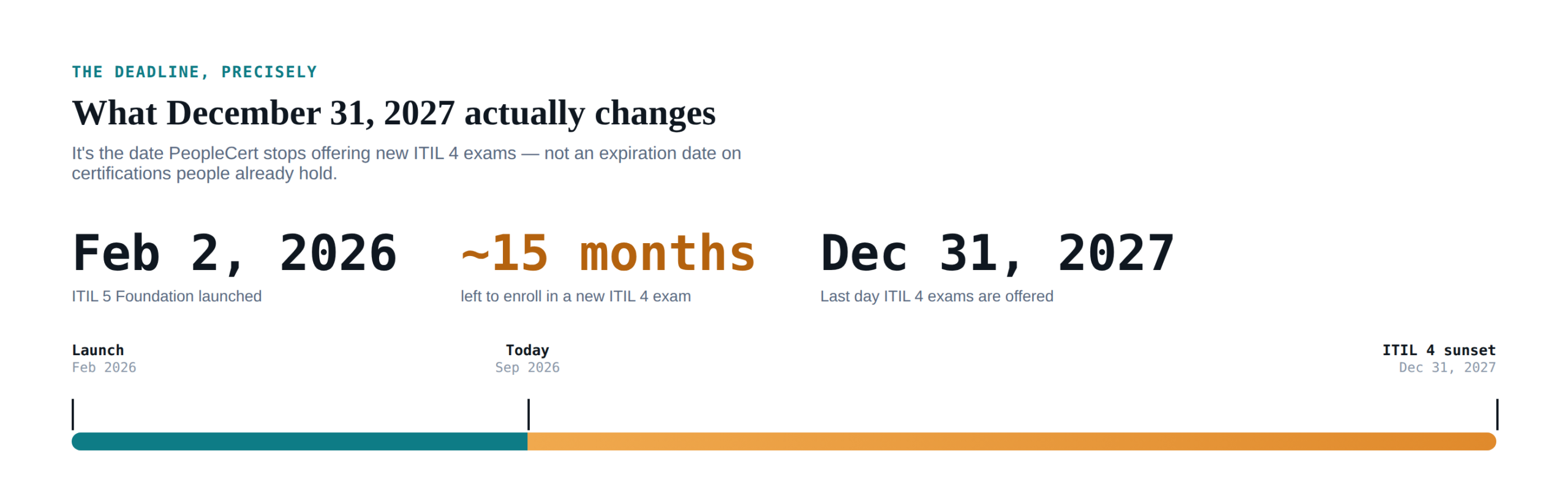
It’s worth being precise about what actually happens on that date, because it gets overstated in some training-provider marketing. December 31, 2027 is when PeopleCert stops offering new ITIL 4 exams. It is not an expiration date on certifications people already hold. If you’re ITIL 4 certified today, you remain ITIL 4 certified after that date — you’d only need to act if you specifically want the Version 5 designation.
How this compares to the last big jump
If you were in the industry for the ITIL 3-to-4 transition in 2019, some of this will feel familiar. That jump also swapped out the framework’s core model (the service lifecycle for the Service Value System), also kept most of the underlying practice content intact, and also produced a year or so of genuine confusion about whether older certifications still counted for anything. They did — exactly as ITIL 4 credentials will keep counting now.
The difference this time is pace. ITIL 3 stayed the dominant version for roughly eight years before ITIL 4 replaced it. ITIL 4 is being superseded for new candidates after about eight and a half years, which is a similar interval — this isn’t PeopleCert suddenly obsoleting things faster than before. What is new is how explicitly this revision is built around a specific external pressure: the rapid, organization-wide adoption of AI tooling in service and product delivery. ITIL 4 addressed AI only glancingly, as a topic under Continual Improvement. ITIL 5 treats it as load-bearing enough to warrant its own capability model and governance publication — a reasonable response to how much has changed in AI tooling since 2019, but also the reason this revision reads as more substantial than a typical mid-cycle refresh.
So: ITIL 4 or ITIL 5, right now?
This is genuinely situational, and the honest answer depends on where you’re starting from.
- Starting from zero, no prior ITIL exposure: go straight to ITIL 5 Foundation. There’s no benefit to learning a framework that’s being phased out for new entrants, and the core practice knowledge transfers either way.
- Mid-way through an ITIL 4 track (e.g., have Foundation, working toward Managing Professional): finishing the ITIL 4 track you’re already in is usually still the pragmatic move before December 2027 — then use the transition module rather than starting the Version 5 track from scratch. Restarting mid-stream typically costs more in total exams than finishing and bridging.
- Already fully certified at a high ITIL 4 level: there’s no urgency. Your certification doesn’t expire, and you can decide whether the Version 5 designation is worth the Transformation module on your own timeline, not a forced one.
Frequently asked questions
Is ITIL 5 actually out yet, or still upcoming?
It’s out. Foundation-level training and examination opened February 2, 2026, and advanced modules have been releasing through the year since.
Do I have to retake ITIL 4 Foundation to get ITIL 5?
No. Existing ITIL 4 Foundation holders can move directly into higher Version 5 modules, with an optional one-day Bridge course available for context rather than a requirement.
Does my ITIL 4 certification stop being valid?
No. Existing ITIL 4 credentials remain valid indefinitely. The December 31, 2027 date affects new exam enrollment only, not certifications already earned.
Is ITIL 5 harder than ITIL 4?
Foundation-level difficulty is comparable — same 40-question, 60-minute, 65%-pass-mark format. The added ground to cover is conceptual (the PSLM, the AI Capability Model) rather than a jump in question volume or pass threshold.
Will my ITIL 4 job title or resume line need to change?
No — “ITIL 4 Certified” remains an accurate, current credential to list. You’d only add or switch to “ITIL 5” wording once you’ve actually sat the relevant Version 5 module.
desqcon’s own ITIL Foundation course and our 2026 ITIL certification path guide are good starting points if you’re mapping out where to begin — and we’re tracking Version 5’s rollout closely as PeopleCert finalizes the remaining advanced modules, so check back as this space keeps moving.
&media=https://desqcon.com/wp-content/uploads/2026/09/thumb-itil5.webp)