Few credentials in IT service management carry the recognition of an ITIL certification. Recruiters look for it, service desks build hiring ladders around it, and enterprise IT teams still treat it as the shared vocabulary for how service value gets created and improved. But the ITIL certification path looks very different today than it did a decade ago, and a lot of people planning their ITIL training still picture the old ladder rather than the one that actually exists in 2026.
That old ladder was ITIL v3 (later called ITIL 2011): a linear climb through Foundation, Intermediate, Expert, and Master, built around rigid process modules like Service Strategy and Service Transition. ITIL 4, introduced in 2019, replaced that structure with something more modular and more relevant to how organizations actually operate – cloud, agile, DevOps, and value streams instead of isolated processes. Instead of one long staircase, ITIL 4 gives you a foundation and then two distinct streams you can combine depending on where your career is headed. Understanding that structure is the first real step in any sensible ITIL career path, so let’s walk through it level by level.
Foundation: The Entry Point Everyone Takes
Every ITIL 4 journey starts in the same place: ITIL 4 Foundation. This is a two-day, internationally accredited course that introduces the ITIL 4 service value system, the guiding principles, and the 34 management practices that replaced the old process model. There’s no prerequisite, which is exactly why it draws such a broad audience – service desk analysts, project coordinators, business analysts, and even non-IT stakeholders who need to speak the same language as their technology teams.
Foundation is deliberately conceptual. It’s designed to give everyone a shared mental model before anyone specializes. At DesQcon, Foundation is delivered as a two-day accredited course across online instructor-led, classroom, online self-paced, and dedicated corporate cohort formats, so the format bends to the learner rather than the other way around. The exam itself is not bundled into the course price, which keeps the offering flexible for organizations that manage exam vouchers centrally.
The Managing Professional Stream: Depth for Practitioners
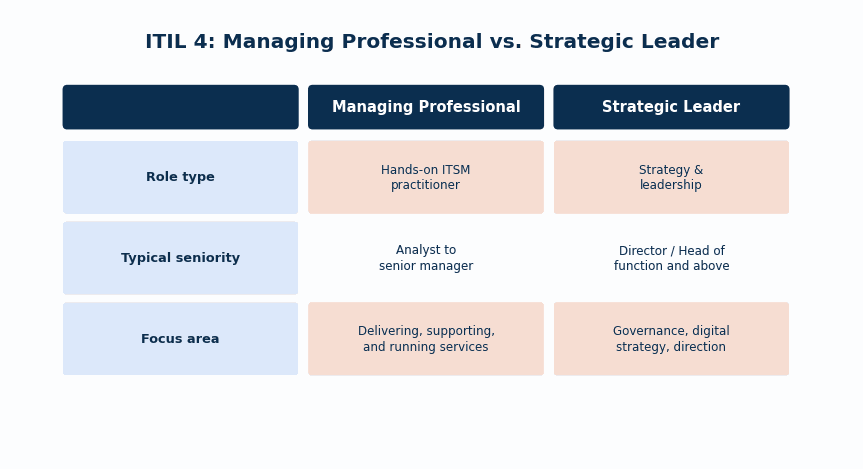
Once Foundation is done, the path splits. The first branch is the ITIL 4 Managing Professional (MP) stream, aimed at people who design, deliver, support, and improve IT-enabled products and services day to day. This is the stream for anyone building a career as a service manager, problem manager, service delivery lead, or product owner inside an IT operation.
The Managing Professional designation is earned by completing four modules:
- Create, Deliver & Support (CDS) – the operational core: how services are built, run, and supported day to day, including incident, problem, and change practices working together.
- Drive Stakeholder Value (DSV) – the customer- and supplier-facing module, covering the entire service relationship from onboarding through to co-creation of value.
- High Velocity IT (HVIT) – digital-first delivery, covering how fast-moving, cloud-native organizations apply ITIL thinking alongside Agile and DevOps practices.
- Direct, Plan & Improve (DPI) – a module shared with the Strategic Leader stream, covering governance, continual improvement, and organizational change at a practical level.
DesQcon runs CDS, DSV, and HVIT as two-day specialist courses, and DSV is the one module in the current catalog where the exam is bundled into the course. DPI, covered next, completes the set. Complete all four and you hold the full Managing Professional designation – the most common target for practitioners who want deeper ITIL learning without shifting into a purely strategic role.
The Strategic Leader Stream: For Direction-Setters
The second branch, ITIL 4 Strategic Leader (SL), is built for people who influence direction and digital strategy across an organization rather than running service operations directly. It requires only two modules, one of which is shared with the Managing Professional stream:
- Direct, Plan & Improve (DPI) – the same module counted toward Managing Professional, focused on strategic direction-setting, governance, risk, and continual improvement at scale.
- Digital & IT Strategy (DITS) – the capstone module for this stream, dealing with digital disruption, organizational strategy, and how IT strategy aligns with overall business strategy.
Because DPI counts toward both streams, it’s the natural pivot point in any ITIL certification plan. Someone who takes Foundation, DPI, and DITS earns the Strategic Leader designation without ever touching CDS, DSV, or HVIT. DesQcon delivers DPI as a two-day Strategist-track course and DITS as a two-day Leader-track course, both exam-not-included, matching the flexibility organizations expect when they’re sponsoring senior staff through certification.
It’s worth noting that many practitioners end up qualifying for both streams over time, since DPI is common ground. Someone who completes CDS, DSV, HVIT, and DPI holds Managing Professional; adding DITS afterward brings Strategic Leader within reach as well, without repeating any coursework.
Master: The Capstone, Not a Shortcut
ITIL 4 Master sits above both streams and is intentionally difficult to shortcut into. It is generally structured to require candidates to already hold both the Managing Professional and Strategic Leader designations – meaning all five modules across both streams – combined with several years of hands-on experience in ITSM leadership or management roles, plus an application and review process administered through the certifying exam institute. There is no standard classroom course that “teaches” Master the way Foundation or a Specialist module does; it recognizes accumulated practice, not a fixed syllabus. For that reason, most realistic ITIL learning plans treat Master as a long-term outcome of a serious career, not a training purchase, and DesQcon’s own catalog focuses on the certifiable modules that actually lead there: Foundation, the Specialist and Strategist modules, and the Leader module.
One more useful DesQcon offering worth knowing about here: the ITIL 4 Managing Professional Transition Module, for people who already hold ITIL v3 Expert-level (or sufficient legacy credit) and want to move into the ITIL 4 scheme without repeating everything from scratch.

Which Stream Fits Which Career Direction
The honest answer to “which stream should I take” depends entirely on where someone wants to be in three to five years, not on which one sounds more impressive.
Managing Professional suits people whose career is built around running and improving service delivery: service desk analysts moving into service management, problem and change managers, service delivery leads, product owners for internal platforms, and anyone whose next title has “manager” or “lead” attached to an operational function. The modules map closely to what these roles actually do all day – supporting services, managing stakeholders, and operating at speed.
Strategic Leader suits people whose influence is shifting upward and outward: IT directors, heads of digital transformation, enterprise architects, and CIOs-in-waiting who need to translate technology capability into business strategy. DPI and DITS spend far more time on governance, portfolio direction, and organizational change than on day-to-day service execution.
A common and sensible ITIL career path looks like this: service desk analyst earns Foundation, moves into a service management role and completes CDS and DSV to reach into Managing Professional territory, becomes a senior service manager, then adds DPI and eventually DITS as they move toward an IT director or CIO-track role. The overlap at DPI means nobody has to choose irreversibly – the two streams are designed to connect, not compete.
How DesQcon Approaches ITIL Training
Certification only matters if it holds up on the job, which is the reasoning behind DesQcon’s “Learn, Pass, Configure” approach to ITIL training: work through the concepts and framework, prepare deliberately for a first-attempt exam pass, then apply the same material hands-on in a live-like instance rather than closing the laptop the moment the certificate arrives. Courses are taught by consultants who implement ITSM and ServiceNow in live client environments rather than full-time trainers reciting a syllabus, which tends to show up in how practical the discussion gets once the slides are done.
Every course in the catalog – Foundation, CDS, DSV, HVIT, DPI, and DITS – is available as online instructor-led, classroom, online self-paced, or a dedicated corporate cohort, so the delivery format can match a team’s schedule rather than forcing everyone into one mode.
Building Your Own ITIL Learning Plan
The practical takeaway for anyone starting or continuing their ITIL certification journey: start with Foundation regardless of eventual direction, then choose Specialist modules (CDS, DSV, HVIT) if the near-term goal is deeper service management skill, or move toward DPI and DITS if the goal is strategic influence. Because DPI sits at the intersection of both streams, it’s rarely a wasted investment either way. Master remains the long-range destination for those who stay in ITSM leadership long enough to combine both streams with real-world depth.
For a longer view of how each certification level maps to specific roles and salary bands, DesQcon’s own ITIL Career Path page breaks the journey down further. And when it’s time to book a course, the full, current schedule across Foundation, Specialist, Strategist, and Leader modules is on the trainings page.