
“ITIL Certification” is often treated as a single line on a resume, but it is really a multi-year career path with several genuinely different destinations , a service desk analyst, a service delivery manager, and a Head of IT Service Management all hold ITIL certifications, but rarely the same ones. This page maps the real ITIL 4 certification scheme to the roles it actually leads to, and to the specific Desqcon Consulting courses that get you through each stage.
If you’re asking any of “ITIL Learning,” “ITIL Training,” or “ITIL Career Path” as a search query, the honest answer is: it depends which of two very different tracks , Managing Professional or Strategic Leader , matches where you want your career to go. Both start in the same place.
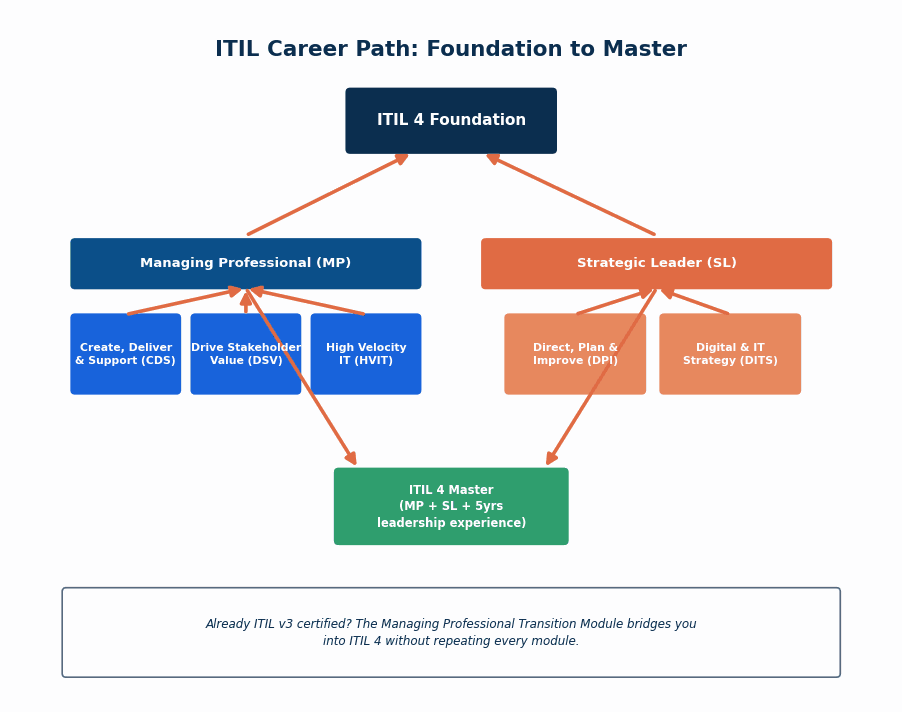
Where the path starts: ITIL 4 Foundation
Every ITIL 4 certification builds on Foundation , there’s no shortcut around it, and there shouldn’t be. Foundation introduces the ITIL 4 service value system, the seven guiding principles, and the 34 management practices that everything else in the scheme assumes you already know. Desqcon Consulting runs ITIL 4 Foundation as an accredited, 2-day course available across all four delivery formats below (the exam itself is booked separately, not bundled into the course).
This is also the level most useful to anyone whose job touches ITSM without owning it outright , business analysts, project managers, IT security managers, and service desk staff all get real, applicable value from Foundation even if they never go further up the path.
Two streams, two different careers: Managing Professional vs. Strategic Leader
This is the fork most people don’t realize exists until they’re standing in front of it. ITIL 4 splits into two designations above Foundation, and they serve genuinely different career directions rather than being “harder” and “easier” versions of the same thing.
ITIL 4 Managing Professional , for people who run ITSM day to day
The Managing Professional (MP) designation is built for practitioners: people managing incidents, problems, changes, service desks, and delivery teams who need practical, workflow-level command of ITSM. Desqcon Consulting’s MP-track courses are:
- Create, Deliver & Support (CDS) , accredited, 2 days, exam not included. Covers how services actually get built, delivered, and supported day to day, including the operational core of incident, problem, and service request management.
- Drive Stakeholder Value (DSV) , accredited, 2 days, exam included. Focused on the customer- and user-facing side of ITSM: journeys, experience, relationship management, and how service value is actually perceived and measured.
- High Velocity IT (HVIT) , accredited, 2 days, exam not included. Aimed at organizations operating in fast-moving, digitally-native environments , relevant if your ITSM function supports (or is becoming) a DevOps/high-velocity delivery model.
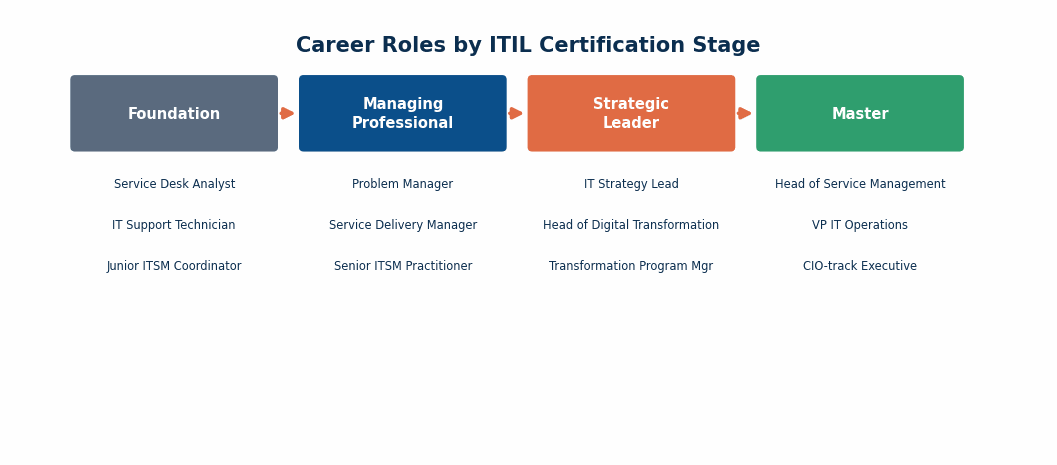
Complete Foundation plus all three of these, and you hold the full ITIL 4 Managing Professional designation. It’s the right target if your career is heading toward Service Delivery Manager, Problem Manager, Service Desk Manager, or a senior ITSM practitioner role.
ITIL 4 Strategic Leader , for people shaping IT strategy, not just running it
The Strategic Leader (SL) designation is built for people who need to connect IT service management to business strategy and digital direction, rather than manage the operational queue themselves. Desqcon Consulting’s SL-track course is:
- Direct, Plan & Improve (DPI) , accredited, 2 days, exam not included. Covers governance, continual improvement, and how strategy actually gets translated into operational direction , this module is also shared with the MP path in the official ITIL 4 scheme, making it a genuine bridge between the two streams.
- Digital & IT Strategy (DITS) , accredited, 2 days, exam not included. The most senior-facing module in the catalog, built around digital transformation strategy, organizational change, and leadership decision-making at the IT-business boundary.
Complete Foundation plus DPI and DITS, and you hold the ITIL 4 Strategic Leader designation. It’s the right target if you’re heading toward IT Director, Head of Digital Transformation, or a CIO-track role rather than a hands-on service management seat.
Already ITIL-certified? The transition path
If you hold legacy ITIL v3 certifications, you don’t need to start over. Desqcon Consulting also offers the ITIL 4 Managing Professional Transition Module, built specifically to bridge existing ITIL v3 Expert-level (or equivalent) holders into the ITIL 4 Managing Professional designation without repeating content you’re already certified on.
The capstone: ITIL 4 Master
ITIL 4 Master sits above both streams and is intentionally the hardest credential in the scheme to earn quickly , it requires holding both the Managing Professional and Strategic Leader designations, several years of leadership/management experience in ITSM, and a practical assignment demonstrating applied capability, not just another exam. Very few practitioners hold it, which is exactly why it carries real weight for Head of Service Management, VP of IT Operations, and CIO-adjacent roles.
How Desqcon Consulting actually teaches these courses
Certification alone doesn’t make someone job-ready, which is why every Desqcon Consulting ITIL course (and our ServiceNow courses) is structured around three outcomes, in order: Learn the concepts, framework, and real scenarios; Pass the certification exam with a genuine first-attempt focus; then Configure , apply it hands-on, in a live-like instance, not just on paper. Courses are taught by consultants who implement these frameworks in live client environments, not full-time trainers reading from a deck.
Every course is available across four delivery formats, so the path above fits around how you actually work and learn:
- Online instructor-led , real-time guidance and feedback from industry experts, from home, with a global cohort.
- Classroom , immersive, face-to-face learning with direct interaction and immediate feedback.
- Online self-paced , full autonomy over pace, same materials and resources as the live sessions, no geographic limits.
- Corporate , a dedicated cohort for your organization, content mapped to the tools and processes your team actually runs, with bulk pricing.
Not sure which stage or stream fits you?
If you’re weighing Managing Professional against Strategic Leader, or wondering whether Foundation alone is enough for where you are right now. That’s a five-minute conversation, not a guessing game. See the full course catalog and book your next module, or tell us your current experience and career goal and we’ll recommend the right starting point on the path above.