
If you’ve searched for the ServiceNow CIS ITSM exam, you’ve probably noticed two things: the search results are dominated by sites promising “real exam questions,” and the official information is scattered across ServiceNow University pages that assume you already know the certification framework. Neither is a great starting point if you’re trying to figure out whether you’re actually ready.
The Certified Implementation Specialist – IT Service Management (CIS-ITSM) credential is generally treated as the natural next step after the entry-level Certified System Administrator (CSA) credential in the broader ServiceNow Certification ecosystem. Where CSA proves you can navigate and administer the platform, CIS-ITSM is meant to prove something more specific: that you can configure the core ITSM applications — Incident, Problem, Change, Service Catalog, Knowledge, and the SLA engine that ties them together — to match a real organization’s process requirements, not just click through an out-of-the-box demo instance.
That distinction matters to employers and hiring managers more than the letters after your name do. A CIS-ITSM credential signals that someone has been evaluated on configuration decisions: how you’d structure assignment rules, build SLA definitions that actually reflect business hours and escalation paths, or decide when a catalog item needs a full workflow versus a simple record producer. This guide covers what the exam tests, what “implementation specialist” means day to day, and how to prepare without wasting time on exam-dump content.
What the CIS-ITSM Exam Actually Tests: The Core Topic Domains
ServiceNow publishes an official exam blueprint for CIS-ITSM through ServiceNow University, and that blueprint is the only fully authoritative source — it’s revised as ServiceNow releases new platform versions, so any percentage breakdown you see anywhere, including this one, should be treated as a snapshot rather than a permanent fact. With that caveat firmly in place, publicly available prep resources and syllabus breakdowns consistently describe the exam as organized around a handful of recurring domains:
- Incident Management — configuration of the incident lifecycle, assignment and routing logic, major incident handling, and related scoping decisions.
- Change Management — change models, change types (normal, standard, emergency), approval workflows, and risk/impact configuration.
- Service Catalog and Request Management — catalog item design, record producers, order guides, and the request fulfillment process.
- Problem Management — the problem lifecycle, its relationship to incident and known error records, and root-cause workflows.
- Service Portfolio Management and CMDB fundamentals — how service offerings and the configuration management database underpin the rest of ITSM, since almost every module eventually points back to a configuration item.
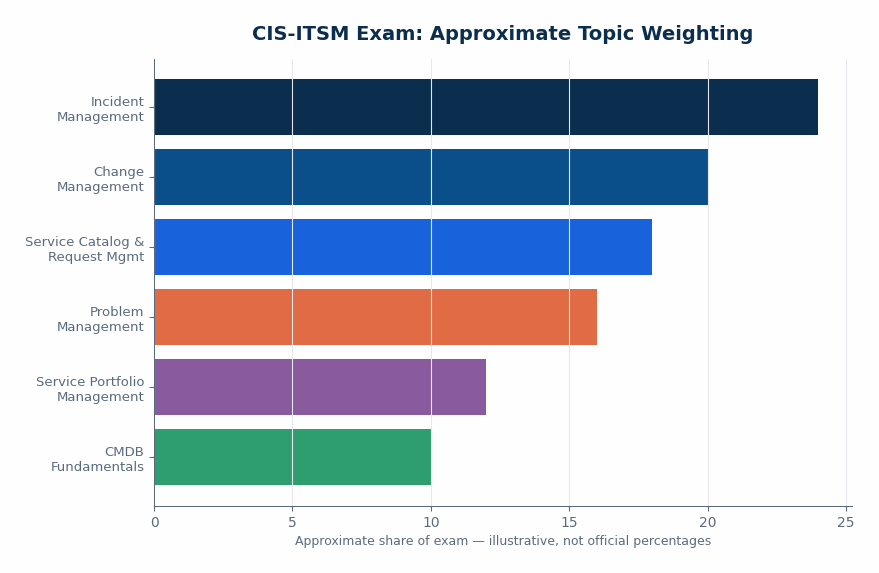
Several independent study guides describe Incident, Change, and Service Catalog/Request Management as the three heaviest domains, each carrying a substantial share of the exam, with Problem Management, Service Portfolio Management, and CMDB making up smaller portions. Knowledge Management and SLA configuration tend to show up as supporting topics woven into other domains rather than standalone sections. Rather than repeat specific percentages that may already be out of date by the time you read this, treat the chart below as illustrative of the general shape of the exam — and confirm the current weighting against ServiceNow University’s official CIS-ITSM blueprint before you finalize your study plan.
Also worth knowing: several sources report that ServiceNow moved CIS-ITSM exam delivery to the Pearson VUE testing platform in late 2025, and that a CIS-Data Foundations credential (covering CMDB and the Common Service Data Model) has been folded in as a prerequisite alongside the long-standing expectation of CSA-level experience. This is exactly the kind of detail that changes with little notice, which is another reason to check ServiceNow’s own certification page immediately before registering rather than relying on older blog posts, including this one.
What “Implementation Specialist” Really Means (Configuring, Not Just Clicking)
A lot of CSA-certified administrators assume CIS-ITSM is just “CSA, but harder questions about the same screens.” That’s a mistake that costs people exam attempts. CSA largely tests whether you can operate the platform: navigate lists, manage users and groups, understand the UI, run basic reports. CIS-ITSM tests whether you can make configuration decisions that hold up in a live client environment.
Concretely, that means understanding trade-offs, not just steps. For example: when should an SLA be built as a straightforward business-hours schedule versus a more complex definition with pause conditions and multiple stages? When does a request need a full flow with approvals versus a simple catalog task? When is it appropriate to extend the out-of-the-box Incident table with custom fields, and when does that customization create upgrade headaches down the road? These are the questions consultants who configure ITSM in live instances every week wrestle with constantly — and they’re the kind of judgment the exam is designed to probe, at least indirectly, through scenario-style questions rather than pure factual recall.
Where CIS-ITSM Fits: CSA, CIS-ITSM, and Other Specialty Tracks
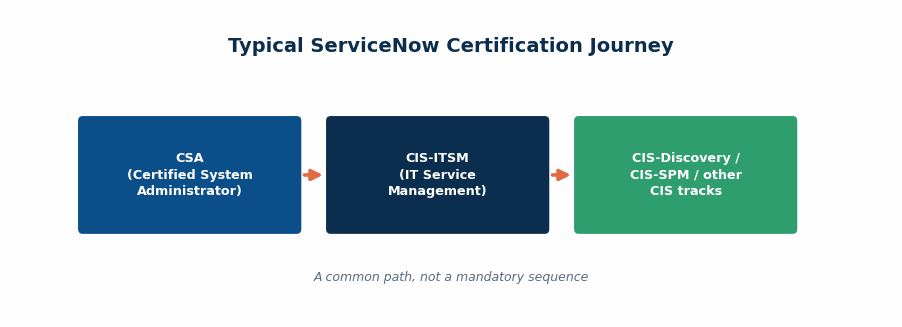
It helps to see CIS-ITSM in context rather than as an isolated exam. ServiceNow’s certification framework is generally structured in layers:
- CSA (Certified System Administrator) — the foundational credential almost everyone is expected to hold before attempting a CIS track. It establishes baseline platform administration skills.
- CIS-ITSM — a specialty implementation credential focused specifically on the core ITSM suite: Incident, Problem, Change, Service Catalog, and related configuration.
- Other CIS tracks — ServiceNow offers a range of parallel Certified Implementation Specialist credentials for other product lines, such as CIS-Discovery (discovery and infrastructure mapping) and CIS-SPM (Strategic Portfolio Management), among others. These sit alongside CIS-ITSM rather than above or below it — they represent different specializations rather than a strict progression.
Someone building a long-term ServiceNow career often earns CSA first, then CIS-ITSM as the first specialty credential (since ITSM is the platform’s original and most widely deployed application suite), and later adds other CIS tracks based on the projects and modules they end up working with — CMDB-heavy discovery work, HR Service Delivery, Customer Service Management, or Strategic Portfolio Management, depending on where their career goes.
How to Actually Prepare for the Exam
The single most useful thing a candidate can do is spend real time in a personal developer instance (PDI), which ServiceNow makes available free for exactly this purpose. Reading about how Change approval workflows are configured is not the same as building one, breaking it, and fixing it. Preparation that works tends to combine three things:
- Structured coursework covering ITSM fundamentals and implementation, so you understand the intended design patterns before you start customizing anything.
- Hands-on configuration practice in a PDI — building out catalog items, configuring SLA definitions, setting up change models, and deliberately testing edge cases like SLA pauses or multi-stage approvals.
- Exposure to real implementation trade-offs, ideally from people who configure these modules for actual clients — which is exactly where a consultant-led training environment adds value that self-study alone struggles to replicate.
Two areas candidates consistently underestimate are CMDB fundamentals and the relationship between Problem and Incident records. Because CMDB isn’t the flashiest part of ITSM, it’s tempting to skim it — but since almost every ITSM process ultimately references a configuration item, a shaky grasp of CMDB concepts tends to show up as unexpectedly missed points across multiple domains, not just its own section. Similarly, candidates who have only ever worked incident tickets sometimes haven’t spent enough time in Problem Management’s known-error workflow, which the exam expects you to understand as a distinct process with its own states and outcomes, not just “the thing you open when an incident repeats.”
It’s also worth deliberately studying the difference between out-of-the-box configuration and customization. ServiceNow ships with sensible default processes, and a meaningful part of implementation skill is knowing when the default is good enough versus when a client’s actual process genuinely requires a customization — and understanding what that customization costs in terms of future upgrade complexity. Exam scenarios often hinge on exactly this kind of judgment call.
Why Exam-Dump Sites Are a Bad Bet for CIS-ITSM
Search “ServiceNow CIS ITSM exam” and you’ll immediately hit sites offering “verified” question dumps and “real exam questions with explanations.” It’s worth being direct about why this is a poor strategy, beyond the obvious ethical issue.
First, ServiceNow’s certification agreement, like most vendor certification programs, explicitly prohibits sharing or using leaked exam content, and violations can result in certification revocation — a real risk if you’re relying on this material and it gets traced back to you. Second, exam blueprints change with every ServiceNow release cycle; a “current” dump from even a year ago may reflect a prior release’s UI, terminology, or emphasis, meaning you could be memorizing answers to questions that no longer match what’s actually configured on today’s platform. Third, and most practically: memorized answers don’t transfer to the job. CIS-ITSM is supposed to signal that you can configure ITSM processes in a live instance. If you pass by memorization rather than by understanding, that gap surfaces the first week you’re asked to actually build something for a client — which is a far worse outcome than spending an extra few weeks in a PDI before sitting the exam.
Ready to Prepare the Right Way?
Studying from official blueprints and building genuine configuration experience takes longer than memorizing a dump site, but it’s the only approach that actually holds up once you’re in front of a client instance. DesQcon is building out ServiceNow certification training — including CIS-ITSM preparation — taught by consultants who configure Incident, Problem, Change, and the rest of the core ITSM suite in live client environments every week. Registration for these courses is opening soon, and seats in the first cohort are limited. If you’d rather prepare with people who do this work professionally than gamble on outdated dump sites, reserve your seat in DesQcon’s upcoming CIS-ITSM training cohort and get in touch to hold your place.
Sources
- ServiceNow University: IT Service Management (CIS-ITSM) Mainline Blueprint
- ServiceNow Community: How to Become Certified Implementation Specialist in ITSM (CIS)
- ServiceNow Community discussion: CIS-ITSM certification, prerequisite and Pearson VUE transition details
- NowBen: ServiceNow Certified Implementation Specialist (CIS-ITSM) Certification Guide
- ProcessExam: ServiceNow IT Service Management Implementation Specialist Syllabus and Exam Details
- CIO.com: ServiceNow certification guide — mastering ITSM