Signing a statement of work with the wrong consulting and advisory partner is a quietly expensive mistake. Unlike a bad software purchase, which you can unwind at renewal, a bad advisory relationship leaves behind half-finished documentation, a configuration management database (CMDB) nobody trusts, and a governance model built around the previous consultant’s methodology rather than your operation.
Part of the problem is that “ITSM consulting,” “HAM consulting,” “CMDB consulting,” and “SAM consulting” get used as if they were one interchangeable service. They are not. A firm skilled at running an incident management workshop may know little about software license true-ups. A systems integrator that installed your ITSM platform also has every incentive to tell you the platform is fine and the problem is your process — admitting otherwise would mean admitting their own implementation had gaps.
This is a practical buyer’s guide to what an ITSM Consulting and advisory Service, a HAM Consulting and advisory Service, a CMDB Consulting and advisory Service, and a SAM Consulting and advisory Service should each actually deliver, the questions to ask before you sign, and the trade-off between boutique vendor-neutral firms and larger systems integrators.
Advisory vs. Implementation: Know Which Engagement You Are Actually Buying
The most common source of disappointment in this market is confusing two fundamentally different kinds of engagement.
A transition and transformation or implementation project is finite: a start date, a go-live date, and a defined scope — migrate a platform, stand up a new ITSM instance, deploy a discovery tool, cut over from one SAM solution to another. Success is judged against a project plan, and once go-live happens and the implementation team moves on, the relationship is largely over unless separately contracted.
A consulting and advisory engagement is different in shape. It is ongoing and deliverable-based rather than milestone-based: periodic health checks against ITIL or ITAM good practice, governance reviews checking whether CMDB data stays current, license position reviews ahead of a vendor audit, and roadmaps revisited as the environment changes. Advisory work assumes the relationship continues after go-live.
Before you sign anything, be explicit about which one you need. Organizations often sign an implementation contract when what they actually needed was an independent health check of a tool they already own — or the reverse, hiring an advisory retainer when the moment called for a focused, time-boxed migration project.
Question One: Who Pays You, and How?
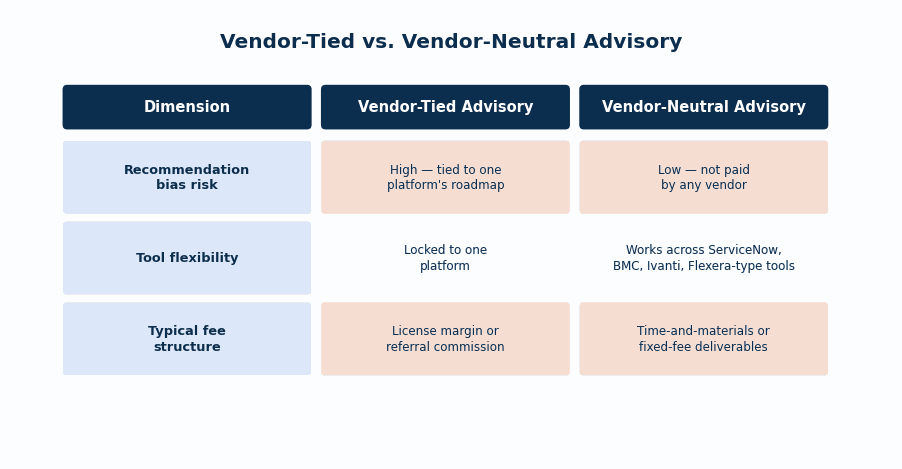
Ask this directly: “Are you compensated by a specific tool vendor for recommending or reselling their platform?” There is nothing inherently wrong with a value-added reseller, but a firm earning margin or referral commission on a specific license is not positioned to give a dispassionate answer about whether that tool is genuinely the best fit — or whether you need a new tool at all versus fixing your process.
A vendor-neutral advisory firm is paid for its time and expertise, not for which product you end up buying. That changes the incentive behind every recommendation that follows: a maturity assessment, a tool rationalization exercise, or a roadmap.
Follow-up questions worth asking in the same conversation:
- “If your assessment concludes we don’t need to buy or replace a tool, will you still tell us that?”
- “Do you hold reseller or referral agreements with any ITSM, ITAM, or discovery tool vendor?”
- “Can we see a sample deliverable from a past assessment with vendor names redacted?”
What Should a Maturity Assessment Actually Deliver?
“Maturity assessment” is one of the most overused phrases in this industry, worth pinning down before you pay for one. A credible assessment for ITSM, HAM, CMDB, or SAM should produce something concrete, not a slide deck of generic maturity-curve graphics with your logo pasted on top.
At minimum, ask what the assessment includes:
- A current-state baseline against a recognized framework (ITIL 4 practices, or an ISO/IEC 19770 reference point for SAM) rather than a proprietary, unpublished scoring model.
- Interviews and data sampling, not just a questionnaire — a real CMDB assessment should query a sample of configuration items against known-good sources to measure accuracy, not just ask your team to self-rate.
- A prioritized, sequenced roadmap tied to business outcomes (reduced audit exposure, faster incident resolution, lower unbudgeted software spend) rather than a flat list of “best practice” items with no order of operations.
- A defined output format and length agreed in the statement of work, so deliverable scope isn’t negotiated after the invoice arrives.
If a prospective partner cannot describe what is inside their maturity assessment beyond “we’ll look at your people, process, and technology,” keep asking questions rather than sign.
ITSM, HAM, CMDB, and SAM: Four Domains, Four Different Diligence Checklists
These four disciplines get bundled under one “IT service and asset management” umbrella in marketing materials, but the expertise required for each is genuinely different, and a generalist strong in one is not automatically credible in the others.
ITSM Consulting and Advisory Service
The core question is whether the firm understands process design and organizational change, not just tool configuration. Ask for a reference where the engagement improved a measurable service outcome — change failure rate, incident backlog, request fulfillment time — rather than simply “we configured the workflow.”
HAM Consulting and Advisory Service
Hardware asset management sits at the intersection of procurement, the CMDB, and physical lifecycle tracking, from receiving and tagging through disposal and data sanitization. Ask whether the firm’s methodology covers reconciliation against procurement and financial records, not just discovery-tool data feeds. A consultant who only speaks in terms of scans may be missing the lifecycle and disposal-compliance side of HAM entirely.
CMDB Consulting and Advisory Service
A CMDB is only as useful as its data is trustworthy, and CMDB engagements fail more often from governance neglect than technical misconfiguration. Ask specifically: “How do you measure configuration item accuracy, and who is accountable for keeping it current after your engagement ends?” A CMDB advisory engagement without a data governance and ownership component is incomplete.
SAM Consulting and Advisory Service
Software licensing is arguably the most specialized of the four — publisher-specific contract terms, effective license position calculations, and audit defense require expertise a generalist ITSM consultant may not have. Ask for a reference client where the firm handled a license true-up or audit response in your specific publisher environment, not just a general SAM tool rollout.
Who Owns the Relationship After Go-Live?
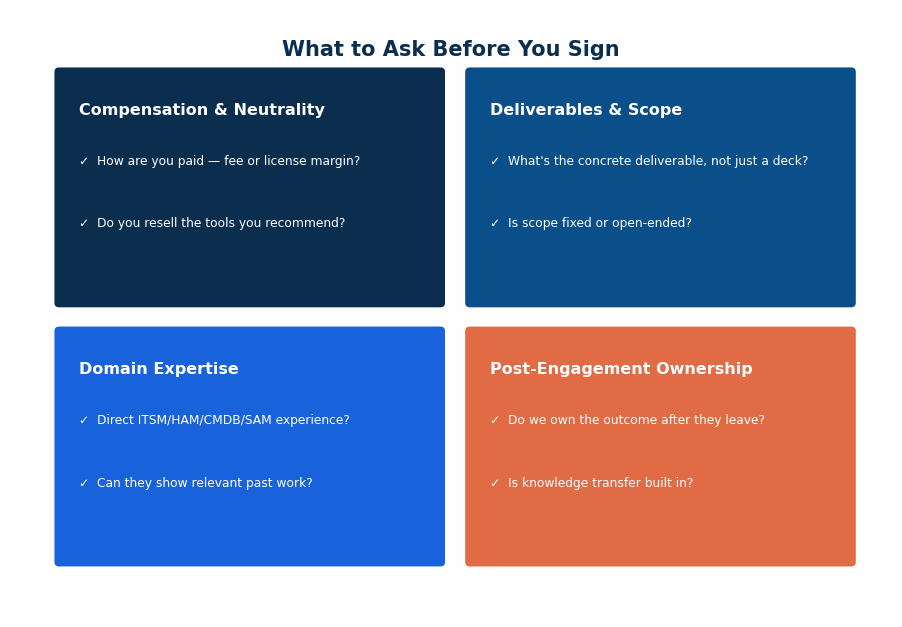
This question surfaces a common gap between what a client expects and what a statement of work actually promises. Implementation-focused vendors are frequently structured so the project team disbands once go-live is signed off, handing you to a generic support queue. If your goal was ongoing tuning, governance, and roadmap work — not just a working system — that handoff leaves you without anyone who understands the context of decisions made during the build.
Ask directly: “After go-live, who is our point of contact, and what is included versus billable?” A genuine advisory relationship should specify a named contact, a cadence (quarterly health check, annual maturity re-assessment), and a clear boundary between what’s included in a retainer and what triggers a new statement of work.
Statement-of-Work Red Flags Worth Walking Away From
A handful of patterns in a proposed SOW are worth treating as warning signs:
- Vague deliverable language such as “best practice recommendations” with no defined format, page count, or acceptance criteria — a common source of scope disputes.
- No named consultants, only “a team of certified experts” — you are being sold a brand, not the people who will do the work.
- Open-ended change order language that lets the firm bill for “additional analysis” without a pre-agreed rate card or approval threshold.
- No exit or knowledge-transfer clause describing what happens to documentation and data if you end the relationship.
- Bundled tool licensing inside the advisory fee, making it hard to separate what you paid for independent advice from what you paid for software.
None of these are dealbreakers alone, but two or more together suggest a firm that structured its contract to protect its own margin rather than a clear, mutual scope.
The Honest Trade-off: Boutique Vendor-Neutral Firms vs. Large Systems Integrators
It would be dishonest to present vendor neutrality and boutique scale as a free win with no downside.
Large systems integrators bring bench depth, the ability to staff a multi-region rollout quickly, and vendor relationships that can smooth licensing negotiations. Their weakness is that the incentive structures described earlier are more likely present, and you may get a rotating cast of consultants rather than a consistent advisory contact.
Boutique, vendor-neutral firms typically offer more senior, consistent staffing and a posture not tied to resale margin — which matters most for maturity assessments, governance reviews, and licensing advice, where independence is the whole point. Their trade-off is more limited capacity for very large, multi-workstream transformation programs across many geographies at once.
The practical takeaway: match the firm’s shape to the engagement. A narrowly scoped CMDB governance review or SAM audit-defense engagement suits a focused, independent advisory firm. A simultaneous global platform migration across a dozen business units may genuinely need a larger integrator’s staffing depth, potentially paired with an independent advisor for oversight.
Before You Sign
Software license audits are not a hypothetical risk — analysis from IT asset management firm Block64 found that 62% of organizations faced at least one software vendor audit in 2024, underscoring why independent SAM expertise, not just a generic ITSM engagement, matters when licensing risk is on the table.
Put the questions in this article in front of any firm proposing an ITSM, HAM, CMDB, or SAM engagement, in writing, before you sign. A partner confident in its independence and its deliverables will answer plainly. One that hedges, deflects, or cannot name a domain-specific reference is telling you something important about what the engagement will actually look like six months in.
DesQcon positions itself as an advisory partner, not just an implementation vendor — vendor-neutral consulting and advisory work across ITSM, ITOM, HAM, SAM, and CMDB, separate from one-time transition and transformation projects. If you are weighing a consulting and advisory engagement, visit the Consulting and Advisory services page to see how these engagements are scoped before you sign anything.
Sources
- Block64, “The Software Audit Surge: Why 62% of Companies Faced Vendor Audits in 2024” — https://www.block64.com/blog/the-software-audit-surge-why-62-of-companies-faced-vendor-audits-in-2024
- ITSM.tools, “Why Being Vendor-Neutral Resolves ITSM Tool Implementation Cost Problems” — https://itsm.tools/why-being-vendor-neutral-resolves-itsm-tool-implementation-cost-problems/
- ServiceNow Community, “Mind the Gap: Driving CMDB Maturity Through Insightful Assessment” — https://www.servicenow.com/community/developer-blog/mind-the-gap-driving-cmdb-maturity-through-insightful-quot/ba-p/3459439
- Atlassian, “What Is CMDB? Configuration Management Database” — https://www.atlassian.com/itsm/it-asset-management/cmdb
- Anglepoint, “Guidelines for Choosing a Software Asset Management Tool” — https://www.anglepoint.com/blog/articles/how-to-select-the-right-sam-tool/
- ServiceNow Community, “Best Practices for Implementing ServiceNow Hardware Asset Management (HAM)” — https://www.servicenow.com/community/ham-articles/best-practices-for-implementing-servicenow-hardware-asset/ta-p/3408791