
Open the ServiceNow certification catalog for the first time and it reads like alphabet soup. CSA, CIS-ITSM, CIS-SPM, CIS-HRSD, CAD, Discovery, CSDM — each one signals a different skill set, a different exam blueprint, and, in some cases, a different career track entirely. For anyone new to the ecosystem, the natural question is simple: where do I actually start? Get it wrong and you can spend months studying for a specialist exam you weren’t ready for, or worse, pass an exam that doesn’t line up with the job you actually want. This guide walks through the real ServiceNow certification ladder, explains why the ServiceNow CSA exam is almost always the correct first stop, and then breaks down the two most common “what’s next” choices — CIS-ITSM and ServiceNow CIS SPM — so you can pick a path that matches your actual career goals rather than whichever exam a job posting happened to mention.
This matters more than it used to. As ServiceNow implementations spread across IT, HR, security, and portfolio management functions, employers are getting more specific about which certification they want to see on a resume, and generic “ServiceNow experience” is no longer enough to stand out. Understanding the structure of ServiceNow Certification tiers — and investing in the right ServiceNow Training track — is the difference between a credential that opens doors and one that just sits on a LinkedIn profile.
Why the ServiceNow CSA Exam Is Almost Always Where You Start
The Certified System Administrator (CSA) credential is ServiceNow’s entry-level, platform-wide certification. It covers navigation, user administration, tables and fields, business rules basics, UI policies, notifications, and the core administrative tasks that apply no matter which application you eventually specialize in. It is not tied to Incident Management, HR Service Delivery, or Strategic Portfolio Management specifically — it is the shared foundation underneath all of them.
That foundation is exactly why it belongs first. Every Certified Implementation Specialist (CIS) exam assumes you already know how the platform works at an administrator level: how roles and ACLs govern access, how data flows between tables, and how workflow pieces fit together. ServiceNow’s own learning paths list CSA, or equivalent system administration training, as a recommended prerequisite before candidates attempt CIS-level exams. Community discussion among certified professionals adds an important nuance here: the platform does not always technically block registration for a CIS exam without CSA in hand, but as one contributor put it, CSA “is mentioned for a reason as pre-requisite” — the CIS material assumes context you simply will not have without it.
There’s also a practical reason to start with CSA: it’s the certification most entry- and mid-level ServiceNow job postings actually screen for. Administrator and junior configuration roles routinely list CSA as a baseline requirement, which makes it the credential most likely to get a resume past an initial filter. Jumping straight to a specialist exam without it tends to backfire — not because the registration system stops you, but because the exam content assumes administrator-level fluency you have not built yet.
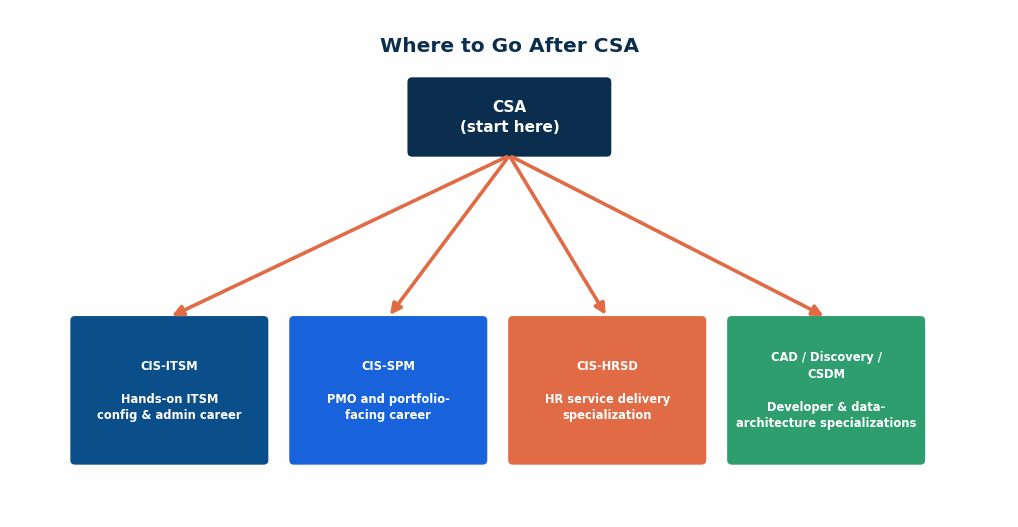
CIS-ITSM: The Path for Hands-On ITSM Configuration Careers
The Certified Implementation Specialist – IT Service Management (CIS-ITSM) credential goes deep into the core ITSM suite: Incident, Problem, Change, and the related configuration items that connect them, such as SLAs, assignment rules, and service level workflows. Where CSA teaches you to navigate and administer the platform generally, CIS-ITSM tests whether you can configure the ITSM applications to match a real organization’s process — approval flows for normal versus emergency changes, problem-to-known-error workflows, incident categorization schemes, and the reporting layered on top of all of it.
This is the natural next certification for anyone whose career is heading toward hands-on ServiceNow configuration and administration work: platform administrators who want to move into a dedicated ITSM configuration role, business analysts who translate process requirements into platform configuration, or consultants who expect to spend their days inside client instances building out Incident and Change workflows. It is also usually the most direct path toward billable implementation work, since ITSM is the module present in nearly every ServiceNow deployment — even organizations that also buy Strategic Portfolio Management, HR Service Delivery, or Discovery are almost always running core ITSM underneath everything else.
CIS-SPM: The Path for Portfolio- and PMO-Facing Careers
The Certified Implementation Specialist – Strategic Portfolio Management (CIS-SPM) credential is a different animal. Instead of testing Incident and Change configuration, it validates your ability to configure SPM for portfolio, program, and project visibility — demand intake, resource management, financial planning at the portfolio level, roadmaps, and the governance structures that let a PMO see and prioritize work across an entire organization. The exam blueprint assumes familiarity with portfolio management concepts as much as platform configuration skill, which is a meaningfully different knowledge base than ITSM.
CIS-SPM tends to suit a different kind of career trajectory: people moving from traditional PMO, portfolio management, or program management backgrounds into the ServiceNow ecosystem, or ServiceNow administrators who want to specialize in supporting an EPMO (Enterprise Program Management Office) rather than a service desk. If a target role talks about resource capacity planning, portfolio prioritization, demand management, or executive roadmap reporting more than it talks about incident queues and change approvals, CIS-SPM is the more relevant credential — and it is generally treated as a separate specialization track from CIS-ITSM rather than a natural extension of it.
CIS-ITSM vs CIS-SPM: How to Actually Decide
If you’re genuinely torn between the two after clearing the ServiceNow CSA exam, a few questions tend to clarify things quickly. First, look at what you already do day to day: if your current or target job involves configuring incident queues, approval chains, or change workflows, CIS-ITSM builds directly on that experience. If your work already involves intake forms, resource allocation, or portfolio roadmaps, CIS-SPM is closer to home.
Second, consider what the surrounding team looks like. ITSM implementation roles tend to sit inside IT operations and service delivery teams, working alongside other admins and configuration specialists. SPM implementation roles tend to sit closer to a PMO or strategy function, working with portfolio managers and finance stakeholders who care less about SLA breach percentages and more about program-level return on investment and capacity constraints.
Third, think about which module the organizations you want to work for have actually deployed, or plan to deploy. ITSM is close to universal among ServiceNow customers, which keeps demand for CIS-ITSM specialists broad and steady. SPM is a faster-growing but comparatively smaller footprint, which can mean less overall demand but potentially less competition among candidates holding the credential. Neither answer is wrong; they simply point toward different kinds of engagements.

Where Discovery, CSDM, CAD, and CIS-HRSD Fit In
Once CSA and a first CIS credential are in place, several further specializations become realistic options rather than overwhelming next steps. Discovery certification validates skills in automated infrastructure and application discovery — the horizontal scanning and mapping work that feeds an accurate Configuration Management Database (CMDB). CSDM (Common Service Data Model) certification goes a layer deeper, validating that you understand how services, applications, and infrastructure should be modeled and related to one another so that CMDB data is actually usable for impact analysis and reporting, rather than just populated.
The Certified Application Developer (CAD) credential moves in a different direction entirely, validating scripting, custom application building, and platform development skills rather than configuration of an out-of-the-box module. It suits people whose career is heading toward custom development on the Now Platform rather than administering or implementing pre-built applications. CIS-HRSD, meanwhile, mirrors CIS-ITSM’s structure but applies it to HR Service Delivery — case management, employee service workflows, and HR-specific configuration — making it the natural choice for anyone specializing in ServiceNow within an HR technology function rather than IT operations or portfolio management.
All of these make far more sense as second, third, or fourth certifications than as a starting point. They assume the same platform fluency that CSA builds, just applied to a narrower domain, which is exactly why sequencing matters: skipping ahead to a specialist exam without the administrator foundation tends to mean re-learning material you could have picked up once, in the right order.
The Bigger Picture: Certifications Track Real Demand
None of this sequencing advice matters much if ServiceNow skills weren’t in genuine demand — but they are. ServiceNow has reported sustained double-digit hiring growth in some regions, and industry commentary describes the role itself evolving: employers increasingly want professionals who can design and govern enterprise-scale workflows, not just configure forms, and ServiceNow has said it is shifting toward skills-based hiring rather than degree-based screening. That shift rewards candidates who can point to a specific, verifiable certification that maps to the work a role actually requires, which is precisely why choosing the right certification, in the right order, is worth the extra planning.
Whichever path fits your goals — hands-on ITSM configuration, portfolio and PMO work, HR service delivery, data architecture, or custom development — the sequence starts in the same place. Pass the ServiceNow CSA exam first, then choose the CIS specialization that matches where your career is actually headed, not just whichever exam happens to be trending. DesQcon’s instructors configure these exact modules in live client instances every week, and our upcoming ServiceNow training and certification courses are built around that real-world sequencing — from CSA through CIS-ITSM, CIS-SPM, CIS-HRSD, Discovery, CSDM, and CAD. Visit our trainings page to see which course fits where you are today.
Sources
- “Is CSA mandatory?” ServiceNow Community discussion
- IT Service Management (CIS-ITSM) Mainline Blueprint, ServiceNow University
- CIS – Strategic Portfolio Management (CIS-SPM) Mainline Exam Blueprint, ServiceNow University
- Why the CIS – Data Foundations (CMDB and CSDM) exam is a prerequisite for select certifications, ServiceNow University
- How to Become Certified Implementation Specialist in ITSM (CIS), ServiceNow Community
- Is ServiceNow Still a Good Career Choice in 2026?, NowBen