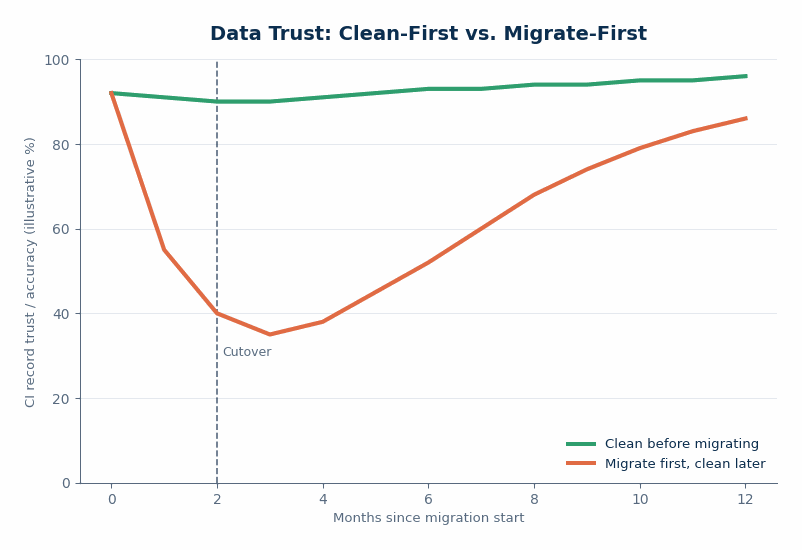
Every CMDB migration starts with a promise: the new platform will finally give a clean, reliable, single source of truth for infrastructure and services. Most teams end up somewhere else. They spend months mapping fields, running an export/import job, and cutting over on a target date, only to discover that the “new” CMDB is full of the same duplicate servers, orphaned relationships, and stale ownership data that plagued the old one. Worse, because a fresh platform carries an unearned assumption of accuracy, teams stop questioning the data as closely as they used to, and errors get baked into every downstream process before anyone notices.
This is the core risk of any CMDB migration: garbage-in-garbage-out does not stay constant when you change platforms, it compounds. A bulk data dump does not clean anything on the way through; it simply relocates every inconsistency, mismatched naming convention, and unreconciled duplicate into a system your teams are told to trust from day one. That is why CMDB migrations need to be treated as a distinct discipline rather than a side task inside a bigger ITSM rollout. A properly scoped CMDB Transition and Transformation Service treats the data itself, not just the schema or the tool, as the thing being migrated, cleaned, and re-earned trust in. Below is a practical, phased approach for getting there, along with the governance work that keeps a migrated CMDB from decaying right back to where it started.
Phase 1: Audit and Clean Current CI Data Before You Touch Migration
The single biggest mistake in CMDB migrations is scheduling data cleanup for after cutover. Teams reason that the new platform’s identification and reconciliation engine will “sort it out.” It will not. Reconciliation rules can suppress some duplicates going forward, but they cannot retroactively decide which of three conflicting owner fields, or five near-identical hostname records, represents the truth. That judgment call has to happen before a single record crosses the wire.
A proper audit phase looks at completeness (are mandatory attributes populated), currency (when was each CI last verified, not just last touched), and duplication (how many configuration items represent the same physical or logical asset under different names or serial numbers). ServiceNow’s own community documentation on CMDB deduplication describes this as an ongoing discipline of identifying, merging, and preventing duplicate CIs, not a one-time script run, and the same logic applies with more urgency right before a migration, since duplicates carried forward get a second, harder-to-detect life in the new system.
Practically, this phase means running the existing CMDB against its own health checks: orphaned CIs with no relationships, CIs with no recent discovery or attestation, relationship types that no longer make sense against how the business consumes services. Anything that fails gets fixed, merged, or explicitly retired before it is eligible for migration. This is unglamorous work, and also the highest-leverage hour spent in the entire project.
Phase 2: Define the Target Data Model and Align to CSDM Before You Move Anything
Once the source data is clean, the next question is not “how do we move it” but “where is it going.” Too many migrations copy the old class structure and naming conventions into the new platform because it is faster, then spend the following two years fighting a data model never designed for how the organization actually delivers services. If the target platform is ServiceNow, this is the point to align deliberately to the Common Service Data Model. ServiceNow’s own guidance frames CSDM alignment as a structured, multi-step exercise covering how business, application, and technical services relate to the infrastructure underneath them, not a checkbox ticked after the fact.
This is also where a target-state data dictionary earns its keep: every class, attribute, and relationship type in the destination CMDB should be defined and agreed with service owners before mapping begins, so source-to-target mapping is a translation against a known destination rather than an improvised one. Skipping this step is how organizations end up with a CSDM-labeled CMDB that still behaves like a flat asset list underneath.
Phase 3: Reconcile Through Discovery, Not Bulk Import Alone
A bulk import is a snapshot; discovery is a verification loop. The two are not interchangeable, and treating an import as the finish line is where “day one” CMDBs quietly become less trustworthy than the one they replaced. ServiceNow’s community documentation on identification and reconciliation explains that these engines exist to determine, using defined identifier rules, whether an incoming record represents a CI that already exists or a genuinely new one, and to apply precedence rules when data sources disagree.
Running the discovery tool against the target environment as part of migration, rather than waiting until after cutover, lets that reconciliation logic catch conflicts between migrated data and what is actually running in production before end users see them. It also surfaces the uncomfortable finding that some portion of migrated CIs no longer exist at all. Treating discovery as a design-time reconciliation partner, not a post-launch enhancement, is one of the most consistent differences between migrations that hold up and ones needing a second remediation project within a year.
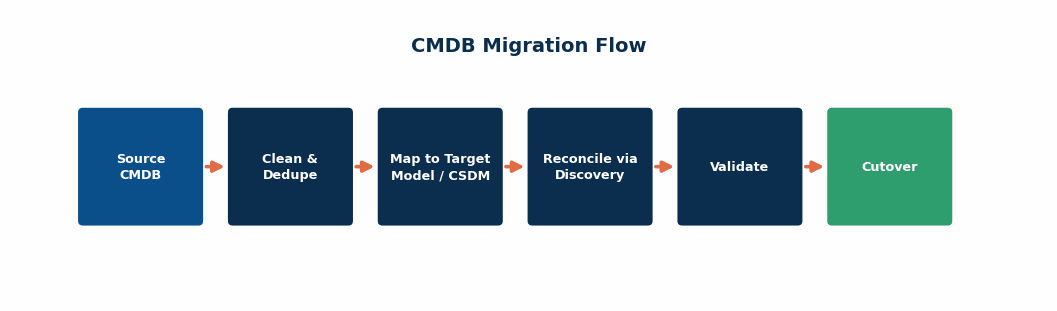
Phase 4: Validate With Real Change and Incident Linkage Before Cutover
Data can look clean in a report and still fail the only test that matters: can the people who rely on the CMDB actually use it to do their jobs? Before cutover, run a sample of real change and incident scenarios against the migrated data. Can a change manager correctly identify every downstream service affected by a planned server reboot? Can an incident responder trace a failing application service back to the infrastructure underneath it in under a minute? If those relationships are missing, mismapped, or point to retired CIs, the migration is not done, no matter how clean the individual records look in isolation.
This validation step also catches a subtler problem: relationships that migrated technically correctly but no longer represent how the business operates, because the source CMDB’s relationship model was itself out of date. Testing against live change and incident workflows, rather than a record count reconciliation, is what turns “the migration completed” into “the CMDB is usable.”
Phase 5: Post-Migration Governance to Keep the CMDB Trustworthy
Cutover is not the end of the project; it is the point where governance has to start carrying the weight a one-time cleanup effort carried during migration. Discovery schedules, attestation cycles, ownership reviews, and data quality dashboards all need to run from week one, not get added later as an afterthought. GB Advisors’ guidance on CMDB data reliability frames this as an ongoing cleanse-and-govern discipline rather than a project with a defined end date, and that framing matters most right after a migration, when confidence in the new platform is high and scrutiny is naturally lower.
Set a measurable baseline for CI health at go-live and track it for the first two to three quarters. If accuracy trends down instead of holding steady, that is a governance gap, not a migration failure, and it needs catching while the team that understands the target model is still engaged.
Why This Should Be Its Own Transition Project
CMDB migrations are almost always proposed as a line item inside a larger ITSM platform swap: “while we’re migrating to the new tool, we’ll also move the CMDB.” That framing is the root cause of most of the failures described above, because it puts the data migration on the same timeline and budget as the platform implementation, with none of the dedicated attention that cleansing, model design, and reconciliation actually require. A platform go-live date is a poor deadline for a data quality initiative; the two have different definitions of “done.”
Scoping CMDB work as its own transition and transformation effort, with its own audit, target-model design, and validation gate before it feeds the new platform, is what keeps data quality from becoming the thing cut when the platform deadline slips. This is also where an outside CMDB Consulting and advisory Service earns its value: a team that has done this specific transition repeatedly can spot the duplicate patterns, mapping traps, and CSDM misalignments hard to see from inside an organization migrating its own CMDB for the first time.
Getting the Sequence Right Pays Off Long After Cutover
The organizations that come out of a CMDB migration with more trust than they started with are the ones that treat the data itself, not just the schema or the platform, as the deliverable. Clean before you map, map before you migrate, reconcile through discovery rather than assuming an import is final, and validate against real change and incident work before calling it done. None of these steps are exotic. What is rare is doing them in order, on their own timeline, with their own accountability, instead of squeezing them into the margins of a platform cutover.
If your organization is planning a platform move and the CMDB is coming along for the ride, it is worth pausing before the first export job runs. DesQcon’s Configuration Management Database services and dedicated Transition and Transformation Services are built specifically around this sequence, so your CMDB comes out the other side more trustworthy than it went in, not less.
Sources
- How to create a duplicate-less ServiceNow CMDB – ServiceNow Community
- 20 steps to align to CSDM – ServiceNow Community
- CMDB – Understanding Identification and Reconciliation Rules and Conflicts – ServiceNow Community
- Ensuring Data Reliability: Proven Techniques to Cleanse and Govern Your CMDB – GB Advisors