
Most IT organizations can tell you, within reason, which software titles are installed and whether they are licensed. Far fewer can tell you, with confidence, where every laptop, server, and network switch physically sits, who is using it, and when it is due for retirement. Hardware Asset Management (HAM) is routinely the least mature discipline inside the broader ITAM function, and the gap shows up as cost, risk, and noise in every audit, incident, and refresh cycle.
The financial exposure is not theoretical. A 2025 survey covered by ITAM Coaches found that organizations are sinking roughly 25% of total IT spending into managing “ghost assets” — hardware that still sits in the asset register but has been lost, stolen, retired without a record, or simply never reconciled against reality (ITAM Coaches). Ghost assets inflate insurance premiums, distort depreciation schedules, waste procurement budget on hardware that already exists somewhere in the building, and — worst of all — create a false sense of security about what devices actually hold company and customer data.
That last point is the real danger. Untracked hardware is an unmanaged attack surface. A decommissioned server never wiped, a pool laptop reassigned without a checkout record, or drives sitting in a supply closet awaiting “eventual” disposal are incidents waiting to be discovered — usually by an auditor, a regulator, or a threat actor rather than by IT itself.
Before layering another discovery tool, CMDB integration, or tracking platform onto this problem, it is worth running a structured HAM Process and Tool Maturity Assessment. The software rarely fails because the tool was wrong; it fails because it was bolted onto an undefined process, or because nobody separated “do we have a good process” from “do we have a tool that supports it.” Those are two different questions, and a serious HAM Process Maturity Assessment answers one while a HAM Tool Maturity Assessment answers the other.
Two Dimensions, Not One: Process Maturity vs. Tool Maturity
It is tempting to treat “we bought an ITAM platform” as evidence of HAM maturity. It isn’t. Process maturity is whether your organization has defined, repeatable, enforced procedures for handling hardware at every lifecycle stage — who approves a purchase, who tags an asset on arrival, who signs off on a wipe before disposal. Tool maturity is whether the systems in place actually capture, automate, and verify that those procedures happened, without relying on someone remembering to update a spreadsheet.
An organization can have a mature process and immature tooling (a disciplined team tracking assets in a well-governed spreadsheet), or the inverse (an expensive discovery platform feeding an unconfigured CMDB). Neither scales. A proper assessment scores both dimensions separately at each lifecycle stage — the only way to know whether the next dollar belongs in process redesign, training, or new tooling.
The Hardware Asset Lifecycle: Where Maturity Gaps Actually Hide
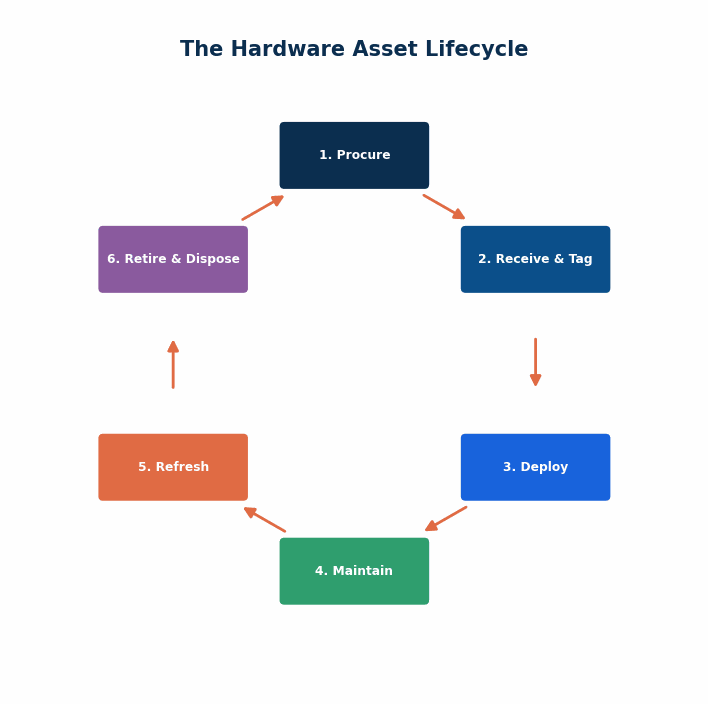
HAM maturity is not a single score; it is the sum of how well an organization handles six distinct stages. Gaps rarely show up evenly — a company might be excellent at procurement and terrible at retirement, which is why stage-by-stage assessment matters more than one overall rating.
1. Procure
Process maturity means standardized purchasing channels, approved vendor catalogs, and a clear link between a purchase order and the asset that will eventually exist. Tool maturity means procurement systems that automatically generate a pending asset record rather than waiting for someone to notice a box arrived.
2. Receive & Tag
This is where many HAM programs quietly break. Process maturity requires every incoming device to be physically tagged and logged before it leaves the receiving area. Tool maturity means that tagging step writes directly into the system of record, rather than a technician promising to “enter it later.”
3. Deploy
Process maturity covers assignment to a named user or cost center and a documented handoff. Tool maturity means the deployment tool or MDM platform updates asset status and ownership automatically, reconciled against what discovery actually sees.
4. Maintain
Process maturity covers scheduled maintenance, warranty tracking, and incident-driven repair. Tool maturity is whether monitoring and discovery continuously confirm an asset is alive, in the expected location, and assigned to the right owner — catching drift before it becomes a ghost asset.
5. Refresh
Process maturity means refresh cycles are planned against lifecycle age and business need, not reactive to failures. Tool maturity means the register triggers refresh planning automatically based on age, warranty expiry, or performance thresholds, instead of a spreadsheet reviewed once a year.
6. Retire & Dispose
Process maturity requires a documented chain of custody: decommission approval, secure data wipe or physical destruction to a defined standard, and certified e-waste handling through a compliant vendor. Tool maturity means the system captures wipe and disposal certificates against the asset record, closing the loop rather than leaving the asset “in limbo” indefinitely. Lansweeper notes that organizations should retain documented proof of data destruction to withstand audit and legal scrutiny (Lansweeper).
Common Failure Modes That Signal Low HAM Maturity
A handful of patterns show up repeatedly in organizations with low HAM maturity:
- Ghost assets: hardware still listed as active that is lost, stolen, or already disposed of, which ITAM Coaches ties directly to the 25% budget-drain figure cited above.
- No continuous lifecycle tracking: records exist at procurement and maybe deployment, then go dark until someone stumbles across the device during an audit.
- Disconnected discovery and CMDB data: network or endpoint discovery tools see devices the asset register does not know about, and vice versa, so nobody trusts either system.
- Poor disposal and data-wipe compliance: devices leaving without documented, verifiable data destruction — a common root cause behind exposure incidents tied to decommissioned hardware (Corodata).
- Manual, spreadsheet-dependent tracking: a process that only works as long as one person remembers to update it.
Worth noting: the ISO/IEC 19770 family — the closest thing ITAM has to a formal standard — was written primarily for software asset management, with ISO/IEC 19770-1 defining tiered, repeatable process areas across the IT asset lifecycle (ITAM Standards). It does not address hardware the way broader physical asset standards like ISO 55000 do. Most HAM programs borrow the same logic — defined processes, tiered maturity, lifecycle-wide accountability — without a hardware-specific ISO framework to lean on, which is why an independent maturity assessment matters more than a compliance checkbox.
The Five Levels of HAM Maturity
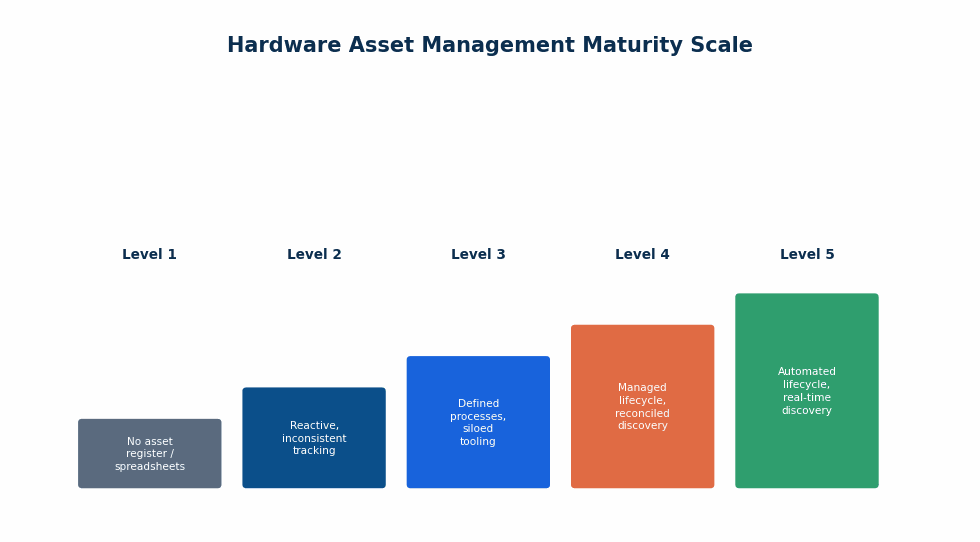
A useful way to frame where an organization stands is a simple five-level scale, moving from ad hoc tracking to a fully automated, lifecycle-aware system of record:
- Level 1 – Ad hoc: no formal asset register; hardware tracked, if at all, in disconnected spreadsheets or memory.
- Level 2 – Reactive: a central register exists but is updated inconsistently, only after incidents or audits force reconciliation.
- Level 3 – Defined: documented processes exist for procurement, tagging, and disposal, with a dedicated tool, but discovery and the register are not fully synchronized.
- Level 4 – Managed: lifecycle processes are enforced with regular reconciliation between discovery and the register; disposal includes documented wipe verification.
- Level 5 – Optimized: real-time automated discovery feeds a live CMDB, lifecycle events trigger workflows automatically, and both maturity dimensions are reviewed on a recurring cycle.
How to Assess Where You Actually Stand
A credible HAM Process and Tool Maturity Assessment does not start with a product demo; it starts with evidence gathering, stage by stage, across both dimensions:
- Reconcile three sources of truth: the procurement record, the asset management system, and live network or endpoint discovery. The size of the mismatch is the fastest proxy for HAM maturity you can produce in a week.
- Interview the people doing the work: receiving dock staff, deployment technicians, and whoever handles decommissioning. Documented process and actual practice often diverge, and the gap is where risk lives.
- Sample the lifecycle at each stage: trace a handful of assets from purchase order to current status or disposal certificate. Missing links reveal which stage needs attention.
- Score process and tooling separately: for each of the six stages, rate process and tooling independently against the five-level scale above, so a strong tool cannot mask a weak process.
- Audit disposal records specifically: confirm every asset retired in the last 12–24 months has a matching wipe certificate and e-waste compliance record — the single highest-risk gap in most assessments.
Only once this picture exists does it make sense to discuss new tooling, CMDB integration, or automated discovery. Buying software to fix an undefined process simply produces a more expensive version of the same gaps — a faster, better-looking spreadsheet.
DesQcon runs vendor-neutral HAM Process and Tool Maturity Assessments that separate process gaps from tooling gaps across the full hardware lifecycle, grounding any software investment in an honest picture of where the real weaknesses sit. If ghost assets, disposal risk, or an unreconciled CMDB sound familiar, explore our Hardware Asset Management services or start with a formal Maturity Assessment to see where your organization stands before your next tooling decision.
Sources
- ITAM Coaches: Ghost Assets Are Costing You 25% of Your IT Budget (citing WanAware’s 2025 “Closing the ITAM Confidence Gap” survey)
- Lansweeper: IT Asset Disposal Best Practices and Data Security Compliance
- Corodata: Improper IT Asset Disposal — Data and Reputation Risks
- ITAM Standards: ISO/IEC 19770-1 Overview