
Most CMDB implementations start with a kickoff meeting, a discovery tool license, and genuine optimism — long before anyone applies a CMDB maturity model to check whether progress is real. Two years later, a large share of them are quietly ignored: change managers stop trusting the relationship data, incident responders go back to asking a person instead of querying a CI, and the “single source of truth” becomes a database nobody wants to open. A widely cited industry estimate put the failure rate of CMDB initiatives at roughly 85 percent, and while methodologies and tools have improved since, the underlying pattern – data that decays faster than anyone can clean it – has not gone away.
The organizations that avoid this fate treat the CMDB as a capability that matures in stages, not a project that gets switched on. That is the purpose of a structured CMDB Process and Tool Maturity Assessment: it tells you honestly which of five stages you are actually in, separate from which stage your tooling vendor’s marketing implies you are in. This post walks through that five-stage model, explains why process maturity and tool maturity have to be scored separately, and gives you a practical way to place your own CMDB on the ladder.
Why CMDBs Decay So Predictably
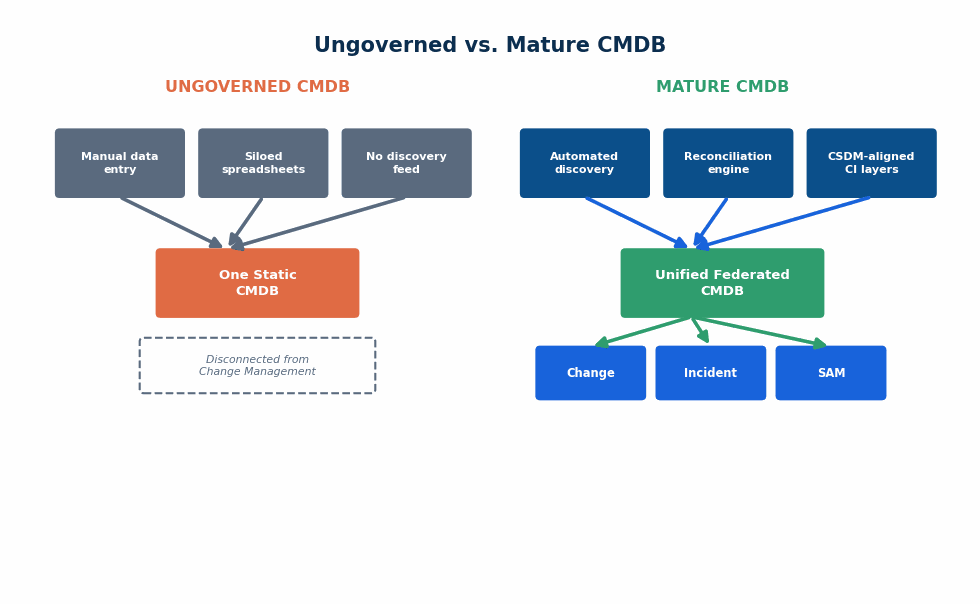
Configuration data has a short shelf life. Servers get decommissioned without a ticket, cloud instances spin up outside change control, and ownership changes hands during reorgs. Without a deliberate process to catch these events, a CMDB does not stay wrong randomly – it drifts in a predictable direction: more orphaned CIs, more stale relationships, more manual entries nobody can verify. Common culprits include CIs with no assigned owner, discovery data that never reconciles with manually entered records, and CI updates that happen independently of the change process that caused them. Each is fixable, but only once you know which stage of maturity you are moving from.
The 5 Stages of CMDB Maturity
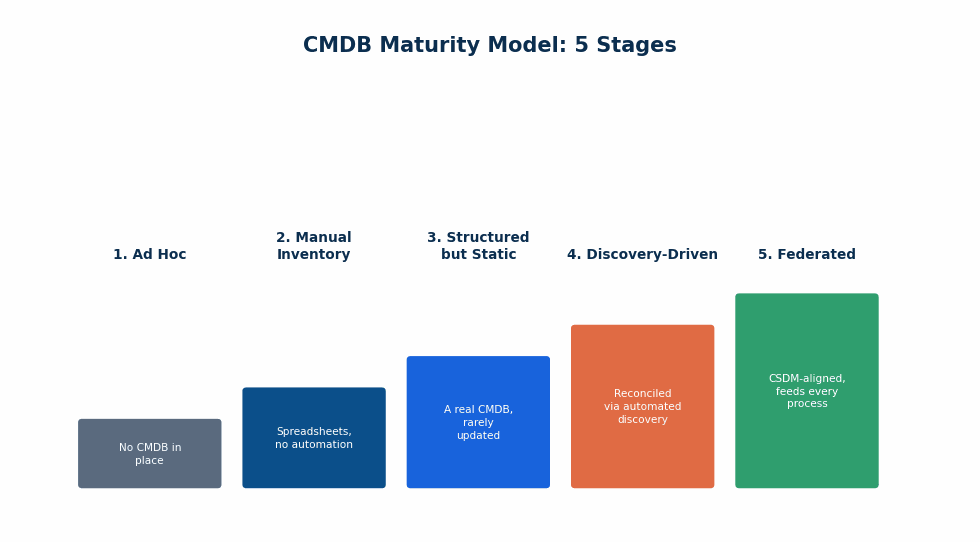
A useful maturity model does not just describe “good” and “bad” – it describes the specific, observable behaviors at each step so a team can see its next move. The five stages below apply regardless of platform, whether your CMDB lives in ServiceNow, BMC Helix, or another ITSM suite.
Stage 1: Ad Hoc / No CMDB
There is no central configuration record at all. Knowledge of what exists and how it connects lives in spreadsheets, in monitoring tool dashboards, and in the heads of a handful of senior engineers. Incident and change processes rely entirely on tribal knowledge, and onboarding a new engineer means shadowing someone for months just to learn the environment.
Stage 2: Manual Inventory
Someone has built a spreadsheet or a basic asset list, and it may even be loaded into a CMDB tool. But population is entirely manual: a person enters a server or application after the fact, if they remember to. There is no discovery, no reconciliation, and no consistent CI naming convention, so duplicate and near-duplicate records accumulate quickly.
Stage 3: Structured but Static CMDB
This is where many organizations plateau. CI classes, attributes, and relationship types are properly defined – often modeled on a framework like CSDM – and the data model looks correct on a whiteboard. However, the CMDB is still populated and maintained largely by hand or through one-off imports. There is no automated discovery feed, so the “structured” data is really just better-organized stale data. It looks trustworthy in a demo and fails the first time someone checks it against reality.
Stage 4: Discovery-Driven and Reconciled
Automated discovery tools now populate and refresh the CMDB on a schedule, and a reconciliation engine resolves conflicts between discovery data, manually entered records, and other identity sources using defined precedence rules. Orphaned CIs are flagged and reviewed rather than left to accumulate silently. This is the stage where the CMDB starts being accurate enough that people stop double-checking it against other sources before trusting it.
Stage 5: Federated and CSDM-Aligned
The CMDB is no longer one monolithic database trying to hold everything – it federates data from asset management, cloud tagging, monitoring, and software asset management sources, presenting a unified view without duplicating ownership of the underlying record. The data model follows a common service data model, or CSDM, so ITSM, ITOM, and SAM consume one structure of services, offerings, and technical CIs rather than three incompatible views of “what we run.” At this stage, the CMDB actively drives decisions – service impact analysis, change blast-radius, license true-ups – instead of being consulted only when something breaks.
CMDB Process Maturity Assessment vs. CMDB Tool Maturity Assessment
A common mistake is treating “CMDB maturity” as a single score tied to which product an organization bought. In practice, tool capability and organizational process are independent variables, and a CMDB Process and Tool Maturity Assessment has to score them separately. An organization can own a highly capable discovery and CMDB platform and still sit at Stage 2 in practice, because the tool’s advanced features were never configured, or because no one owns the governance around them.
CMDB Process Maturity Assessment: Ownership and Governance
A CMDB Process Maturity Assessment looks at the human side: does every CI class have a named owner? Are CI updates linked to change management, so a change record triggers a review of the affected CIs? Is there a data steward accountable for CMDB health metrics, and does leadership actually review them? Process maturity also covers governance cadence – a recurring audit of CI accuracy, a documented CI lifecycle policy, and clear escalation when data quality drops below an agreed threshold. Without this layer, even the best discovery tool eventually drifts, because nobody owns the exceptions it surfaces.
CMDB Tool Maturity Assessment: Discovery, Reconciliation, and Federation
A CMDB Tool Maturity Assessment, by contrast, looks at technical capability: what percentage of the estate is covered by automated discovery, versus manual entry? Are reconciliation rules defined with clear source precedence, or does “last import wins” by default? How deep is the integration between the CMDB and adjacent systems – cloud APIs, monitoring, software asset management – and is it federated, referencing authoritative data in place, or duplicated through brittle point-to-point imports? Tool maturity also considers whether the data model follows CSDM principles, since an excellent discovery feed populating a poorly designed schema still produces unreliable relationships between services and the infrastructure supporting them.
How to Assess Where You Are Today
Placing a CMDB on this five-stage model does not require a lengthy audit. A focused assessment works through four practical steps:
- Sample and verify. Pull a random sample of 30-50 configuration items across different classes and manually verify them against reality – is the server still running, is the owner still correct, does the application relationship still hold? The error rate you find is a fast proxy for overall data trust.
- Trace the update path. For each CI in your sample, ask how it last got updated: automated discovery, a change ticket, or a person editing a field. A high share of manual, untraceable updates signals process immaturity even if the tool is capable.
- Check reconciliation logic. Confirm whether conflicting data from multiple sources is resolved by defined precedence rules or left to whichever import ran most recently. Absent or poorly configured reconciliation is one of the most common reasons discovery-capable tools still produce Stage 2 or Stage 3 results.
- Map the data model against CSDM. Compare your current CI classes and relationships against a CSDM reference model to see how far your schema is from separating services, offerings, and technical components cleanly – this gap is often the difference between Stage 3 and Stage 5.
Scoring these four areas separately for process and for tooling gives a far more actionable picture than a single “maturity score,” because it tells you exactly which lever to pull next – better governance, better discovery coverage, or a CSDM-aligned redesign of the data model itself.
Moving Up the Ladder Deliberately
No organization jumps from Stage 2 to Stage 5 in one project. The realistic path is incremental: fix ownership and governance gaps first, since a technically perfect CMDB with no accountable owners will decay again within a year. Then extend discovery coverage and tune reconciliation so the data stops requiring manual verification. Only after that foundation is solid does a CSDM-aligned, federated architecture pay off – building an elegant data model on untrustworthy source data just produces a more elegant version of the same problem.
A vendor-neutral assessment is valuable precisely because it has no incentive to claim that more of a particular tool solves a governance problem, or that a workshop solves a discovery coverage gap. An honest, separated read on process and tool maturity is usually the fastest way to find out which stage you are really in – and what the next one actually requires.
If you want a structured, vendor-neutral read on where your configuration management program stands, DesQcon’s CMDB Maturity Assessments are built around this exact five-stage model, scoring process and tool maturity separately so you get a concrete roadmap instead of a generic score. You can also learn more about our approach to configuration management on our Configuration Management Database page.
Sources
- Why 85% Of Companies Fail At Creating A CMDB – Forbes / SungardAS
- Break the CMDB Failure Cycle With a Service Asset and Configuration Management Program – Gartner
- A CMDB Without Discovery Is Just a Database – Virima
- What is CSDM (Common Service Data Model)? – ServiceNow
- When to Use Federated Data – BMC Documentation
- CMDBf – Configuration Management Database Federation – DMTF